
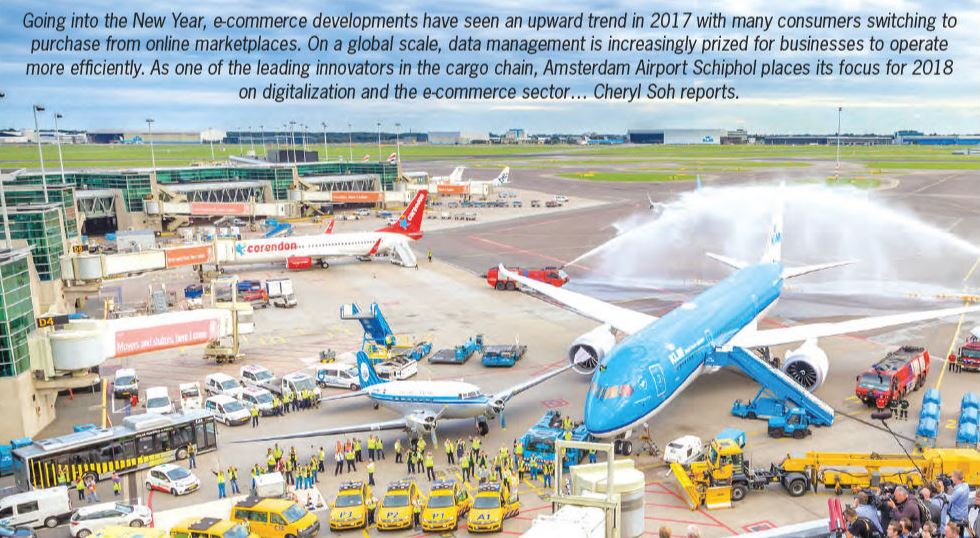
Recent years have seen multiple milestones for Amsterdam Airport Schiphol, with the airport being awarded Best Airport Europe, for the third time in a row, from the Asian Freight, Logistics and Supply Chain in 2017. In 2016, the Schiphol group also celebrated its 100-year milestone and was awarded the Royal status.
The demand for e-commerce
Now the Schiphol group’s largest cargo market, e-commerce is also responsible for strengthening the China market. The airport has been facilitating the delivery of a wide range of goods to Chinese online consumers, following the demand and rise of exports to China.
Between January and June last year, cargo volumes at Schiphol grew 8.7 per cent to 866,713 tonnes as compared to the same period the year before; and a series of new initiatives have been credited to it. Volumes to the Far East grew to 27,706 tonnes in June 2017, up 15 per cent compared to the year before; and inbound Far East volumes reached 26,511 tonnes in the same month, which was also up 14.1 per cent compared to the previous year. Half-year figures for the Far East were 154,866 tonnes for outbound, going up 12.2 per cent from 2016, with inbound figures at 149,836 tonnes, up 8.3 per cent analysing the same period the year before.
“We suspect that rising e- commerce activities are contributing to the rise in cargo flow between the Chinese hubs and Schiphol,” says Jonas van Stekelenburg, Head of Cargo at Amsterdam Airport Schiphol. “Historically, China is recognised as the world’s leading manufacturer, but Chinese consumers are increasingly sourcing for a wide range of online luxury items from The Netherlands and across Europe. The demand has resulted in a significant trend or the increase in imports into China for goods bought on online marketplaces.”
In 2016, the Dutch customs implemented a simplified electronic customs declaration, resulting in a quicker and more efficient way of processing exported and imported e-commerce cargo. Postal parcels, on the other hand, are handled through the PostNL gateway at the airport or are seamlessly dispatched throughout Europe via other last mile delivery services.
On top of that, Schiphol has worked together with the Dutch customs to specifically establish a ruling for faster customs clearance for low-value e-commerce shipments with the Chinese authorities. The ‘Venue’ declaration is designed to assist smaller shippers with making multiple declarations for parcels travelling to separate destinations.
Cool chain and pharma handling taken up a notch
“Additionally, a little over a year ago we launched the Holland Flower Alliance (HFA), a collaboration between KLM Cargo, Royal FloraHolland, and Schiphol Cargo, to optimise the flower cool chain at Schiphol,” says van Stekelenburg. The alliance works on initiatives such as flower packaging and information sharing to improve the floral supply chain from grower to buyer.
The Schiphol group also launched Pharma Gateway Amsterdam (PGA) in 2016, which aims to create the ideal pharma logistics cool chain. In its first year of operations, PGA has since supported multiple members to become CEIV accredited in 2017. “Together with partners in the chain, we strive for a CEIV certified cool chain in which pharmaceutical shipments move through the supply chain as seamlessly as possible,” says van Stekelenburg.
Furthermore, the Schiphol group has been awarded a Euro 1 million grant from the government; which van Stekelenburg says will be put towards the development of an early warning system for pharmaceutical shippers, that will alert them of any issues regarding their shipment and allow the airport to address the problems much faster as well.
Towards the end of 2016, the Dutch King opened the Joint Inspection centre (JIC), which is just one of the operations that fell under the Schiphol Smar tGate Cargo (SSG C ) . The programme is a joint initiative between the Dutch Customs Administration, Amsterdam Airport Schiphol, KLM Cargo, and Air Cargo Netherlands (ACN).
Designed to make freight handling at Schiphol safer and more efficient, the JIC enables different enforcement and inspection authorities to carry out airfreight checks together. The centre also includes a shipping floor, scanning hall, storage and examination rooms, a quarantine area for small animals, garages for scanning vehicles, offices and a training centre.
“At Schiphol, cooperation between airlines, handlers, forwarders, customs, and others is in our DNA,” said van Stekelenburg. “Throughout 2018, we will build on this, with a focus on digitalisation. This is an important topic for the airfreight world today, and we will work on increasing airfreight data exchange at Schiphol. A common ground for all logistical companies at Amsterdam lies in the communication with customs, and we will build upon the digitalisation of ‘our’ airfreight with this insight in mind.”
Upping the ante on digitalisation
The Milkrun project initiated by the Schiphol group is based on the idea that the handlers in the cargo community should be the principal players in the import freight process. As part of the initiative, cargo destined for multiple forwarders is combined in one truck and delivered to their respective docks. Handlers will then link airborne shipments to forwarders, resulting in an early sharing of information within the chain. This way, all parties are able to handle their resources- which include managing people, warehousing, space, last-mile delivery times- at a more efficient rate.
According to van Stekelenburg, the Milkrun project is now entirely self-sustainable and is coupled with a fully automated Milkrun Portal and data dashboard. The portal provides information on which freight shipments are arriving- when, where, and with which airline.
On the other hand, the data dashboard automatically pulls information from the members’ own systems, rather than having to be built using a manual data input; resulting in more reliable data, time savings, and lower costs. Performance insights are too fully automated, with parties involved to be able to independently interpret their own data, control participation and increase efficiency.
“For just over a year now, our online Compliance Checker, developed by Cargonaut, has been facilitating customs procedures at Amsterdam Airport Schiphol by automatically analysing the content and format of declarations to predict any issues,” said van Stekelenburg. The Compliance Checker is part of Schiphol’s Smart Cargo Mainport Programme (SCMP), a plan for becoming a smarter airport through digitalisation. The system speeds up cargo flows by detecting data errors in air waybills and sending automatic alerts when the information is found to be incorrect; increasing efficiency by preventing delays caused by sending non-compliant cargoes to the customs.
Further under SCMP, a distinction was drawn between shipments with shorter connecting times and those with less time pressure with a new schedule. The schedule marks a step towards setting up a Cloud platform that facilitates data exchange among parties, where real-time data can be reused, supplemented or modified. Additionally, the information is automatically verified against customs regulations and safety standards to efficiently support and facilitate the exchange of status information relating to shipments.
Van Stekelenburg also says that an API platform, as part of the SCMP, will also be used for more digitisation initiatives; which includes facilitating the exchange of data among cooperating parties, and more. He continues on to share that the air cargo industry needs API platforms and other cloud-based data systems that will allow for all data to be collected. This includes data gathering with regards to the contents, which will be useful for customs and other authorities, and not just information regarding the shipment, which is useful for the logistics side. As far as innovations go, data has to allow for more predictability in order for the supply chain to become more efficient.
Limitations to air traffic movements
Due to a slot capacity restriction of 500,000 air traffic movements per year until 2020 affecting full cargo carriers, the Schiphol group has seen a decrease of 11.6 per cent in full freight movements. “We expect this fi gure to remain about the same for this IATA winter season. We also expect a decrease in volumes, as almost half of the AMS cargo is flown in passenger planes,” says van Stekelenburg.
The activity in Schiphol continues to see growth, which saw a reduction in freighter calls as slots are re- allocated elsewhere. However, it is further understood that when Air Co-ordination Netherlands (ACNL) and the airlines involved are deciding on when slots should be allocated, part of the latter that fails to adhere to 80 per cent of requested flight schedules and are much more likely to lose out as per IATA and European Union regulations. As a result, non-historical and leased slots are increasingly affected by the limitations; and with the unpredictable nature of air cargo, freighter operators are less likely to hit the 80 per cent mark. Van Stekelenburg continues that the team at Schiphol are constantly working on improving the quality of operations. As part of the airport’s focus for the new year, digitalisation and data sharing is all the more imperative with the increasing e-commerce activity and changing players in the cargo chain.
Subsequently, the Schiphol group recorded a 0.9 per cent decrease in volume as compared to the year before, with tonnage in October 2017 seeing a 0.9 per cent increase compared to the same month last year. Van Stekelenburg continued to give a prediction of a 10.5 per cent decrease in tonnage and a 6 per cent decrease in volume for 2018 as compared to 2017.
Last year has seen significant growth, with air freight volumes seeing an upward trajectory with year-on-year growth of FTKs rising to 10.4 per cent during the first half of 2017. E-commerce developments have seen an upward trend as well, with the rise of online marketplaces and increasing consumer demands worldwide. Advancement in technology coupled with the adoption of digitalisation has enabled the air cargo industry to significantly improve data management. As a result, there is a trove of potential to increase efficiencies via innovations. Despite the limitations on air traffic movements, the Schiphol group continues to keep the focus on digitalisation and leveraging on the e-commerce boom through a series of initiatives…setting its pace for the new year.