
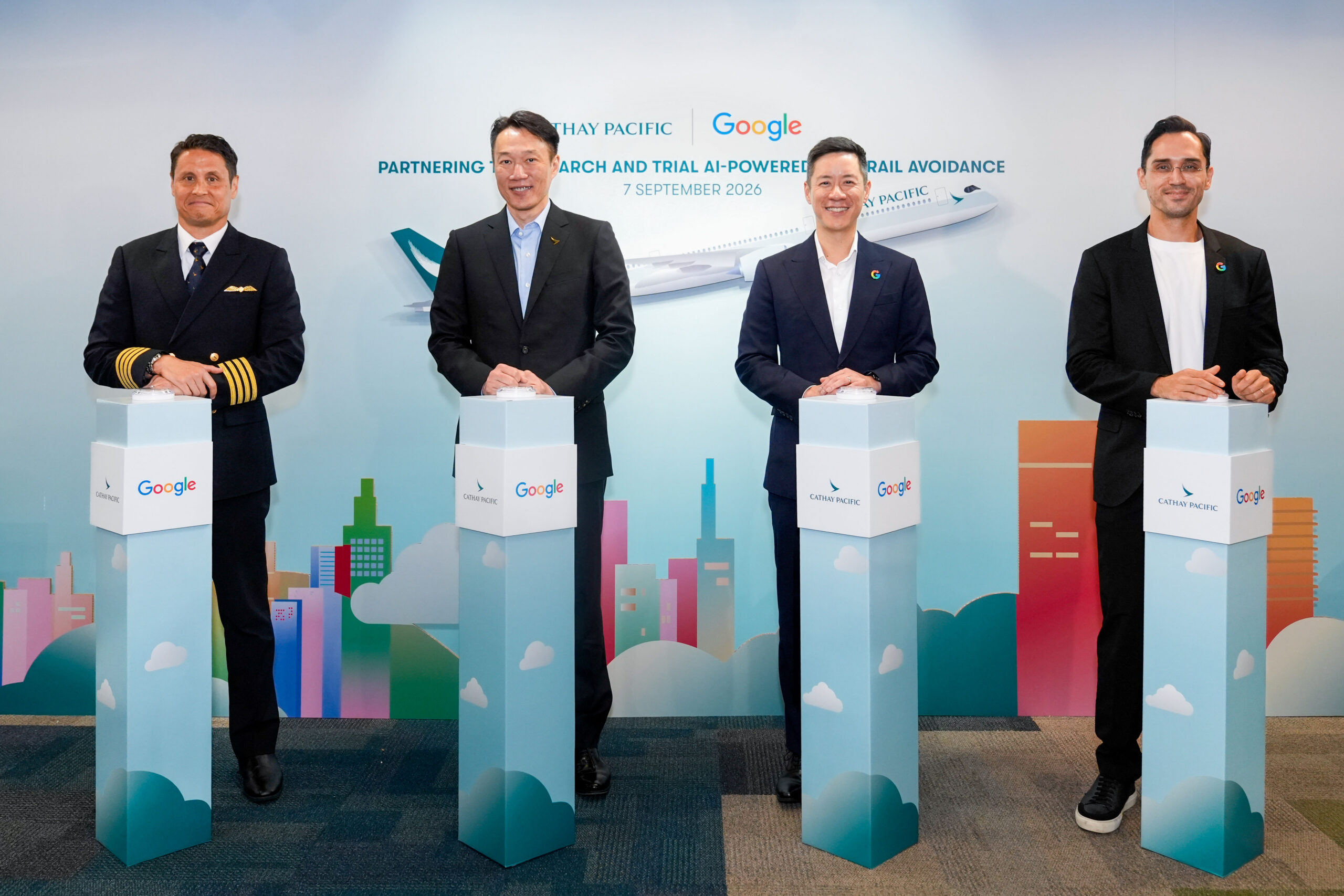
Cathay Pacific and Google announced a partnership to advance research on contrails and their contribution to aviation’s climate impact. Cathay Pacific is Google’s first commercial airline partner in Asia-Pacific to trial its AI-powered contrail mitigation technology, and the first airline globally to test contrail avoidance on ultra-long-haulflights. The companies have started trials to evaluate the operational feasibility and constraints of contrail avoidance across Cathay Pacific’s extensive global network. The trials will contribute valuable new data to global contrail research and advance understanding of contrail formation and avoidance in the Asia-Pacific region, a geography that has been underrepresented in previous trials. The real-world data gathered through the trial would allow the industry to better understand the climate benefits of contrail avoidance in actual operational environments.
The thin white lines that sometimes form behind aircraft in the sky are known as contrails, or condensation trails. They are clouds that form when aircraft fly through certain cold and humid conditions at high altitude. While many disappear quickly, some persist and spread into broader cloud formations that can trap heat in the atmosphere. Previous research suggests these persistent contrails could account for around one-third of aviation’s total climate impact, making them an important area of study alongside carbon dioxide (CO₂) emissions.
Cathay recognises aviation’s contribution to climate change and is working towards addressing the climate impacts through multiple approaches. Reducing CO₂ emissions remains a primary focus for Cathay through fleet modernisation, operational efficiency improvements and the adoption of sustainable aviation fuel (SAF). At the same time, the airline recognises the importance of growing scientific understanding of non-CO₂ climate effects, including contrails.

Through this partnership, Cathay Pacific and Google are supporting contrail research using real-world operational data from flight trials. The insights will help build further understanding of the impact and possible actions airlines can take against individual contrails, while exploring how contrail avoidance could be implemented and managed at scale across the aviation industry.
AI in the cockpit shows encouraging early results
Google’s contrail mitigation solution combines AI-based predictive models, satellite imagery detection tools, and extensive weather intelligence to forecast contrail-forming zones. This actionable data allows flight dispatchers and pilots to make informed altitude adjustments, navigating around these zones much like they routinely do to avoid turbulence.
Onboard, Cathay Pacific leverages its modernised fleet capabilities, combining in-flight Wi-Fi connectivity with its proprietary, in-house developed Electronic Flight Folder (EFF). The EFF system equips pilots with dynamic Google contrail forecasts alongside real-time operational parameters, enabling seamless decision-making in the cockpit without disrupting normal operations. An operational trial began in late 2025, with more than 100 flights targeted across Cathay Pacific’s network. Over 80 flights followed contrail-avoidance routes1, and Google estimates that these flights achieved roughly a 40% reduction in the warming impact of contrails.
The Hong Kong-Singapore corridor was one of the routes tested, as flights in this airspace frequently encounter conditions where persistent contrails form. Early analysis indicates that minor altitude adjustments can successfully prevent contrails, with actions taken on this single route accounting for more than 50% of the trial’s total climate impact.
Lawrence Fong, Director Digital and IT, Cathay said: “Aviation needs solutions to address climate change, and AI is accelerating that progress. This partnership combines Cathay’s operational expertise with Google’s world-class AI capabilities to tackle complex sustainability challenges at scale. At Cathay, we believe innovation should deliver tangible and meaningful impact, and this collaboration sets a new benchmark for leadership in our industry.”
Michael Yue, Managing Director and General Manager, Google Hong Kong, said: “At Google, we believe AI has the power to help address complex environmental challenges, and our partnership with Cathay Pacific is a prime example of this in action—researching how predictive AI can be deployed in live operations to help address the climate impact of contrails with today’s aircraft and today’s fuel. This work reflects our ongoing commitment to developing sustainable solutions that deliver lasting impact, and we’re excited to expand our trial with Cathay Pacific and continue contributing to open climate science together.”
Shaping the future of aviation
The initial trial provided valuable experience for integrating predictive AI data in live flight planning to support contrail avoidance at the flight level, while bringing together the operational and technical stakeholders needed to make such trials possible. While the partnership delivered encouraging results on individual flights, further trials and research are needed to assess the benefits of applying contrail avoidance measures across airlines and airspaces. The availability of such robust scientific evidence will enable further industry considerations and policy development by airlines, regulators, and other industry players.
Therefore, the partners are embarking on a larger second phase of flight trials to generate a broader set of real-world operational data and further insights across Cathay Pacific’s Asia and transpacific network. Contrails.org, a nonprofit initiative dedicated to advancing the science of contrail mitigation, is also a partner in the project. The ongoing partnership aims to generate a robust operational data set to further scientific understanding of contrail avoidance and help inform future industry best practices.