

The International Federation of Freight Forwarders Associations (FIATA) wrapped up its annual world congress in Vancouver late last month on a positive note. Five days of official committee meetings, discussions, networking and socialising, as well as a three-day exhibition were branded an overwhelming success by FIATA president William M. Gottlieb, who remarked that the notoriously wet west coast weather had even largely cooperated.


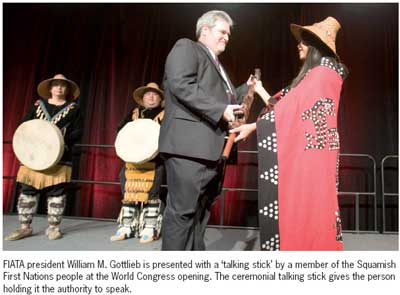
The 800-strong contingent of freight forwarding delegates from 85 countries and regions were treated to Canadian hospitality from the event’s hosts – the Canadian International Freight Forwarders Association (CIFFA) – which offi cially kicked off on 23 September with a welcome by members of the Squamish First Nations people who presented a symbolic ‘talking stick’ to Gottlieb before saying a tradition prayer for the event and its attendees.
Gottlieb highlighted some of the areas where progress had been made during the congress, including issues such as dangerous goods, legal issues, customs affairs, security and training, along with various information sessions and housekeeping issues for each of the FIATA regional groupings.
“We work through consensus and things don’t always happen as fast as in a corporate business setting so everything is a bit of an evolution,” Gottlieb said, adding that a key aspect of the congress is to keep members informed of both ongoing FIATA work, as well as larger industry developments.
“It would be nice to say that there’s been a defining moment that we’ve had a great success, but many of our successes are a result of quietly pushing the agenda in a direction that helps freight forwarders become more efficient that hopefully translates down to the actual supply chain level.”
At the meeting’s close the executive council also inducted 12 new freight forwarding associations, two from Southeast Asia – Brunei and Cambodia – as well as 10 associations from Latin America. This brings the total membership up to 107 organisations from around the world. Th ree organisations were also dropped from the Fiata roll due to prolonged non-payment of fees, although it was noted that contactis always maintained in the hopes of bringing wayward associations back intothe fold.
Economic environment
Despite the upbeat mood, the world congress was never-the-less held against the backdrop of an increasingly tumultuous economic and financial environment. Gottlieb acknowledged that turmoil in the financial markets and a downturn in consumer sentiment will have an impact on global trade, and hence will impact freight forwarders.
While there has been some realignment of manufacturing in order to bring suppliers closer to manufacturers to avoid having supply chains stretching half-way around the world, outsourcing to low cost centres is still prolific and could pose serious challenges should fuel prices remain historically high, he said.
“We wonder how the turmoil in the financial markets will affect the ability of carriers to raise capital to renew fleets and meet existing requirements should the marketplace soften depending on consumer sentiments and spending habits,” the FIATA president said.
“I think these are all questions that we as forwarders are concerned about. But the bottom line is that the freight forwarding community is very resilient and we’re there to serve our customers. If it means they are going to source their goods closer to home or change their patterns we have the fl exibility, particularly for those of us who are non-asset based, to find the solutions to their importing needs.”
“Certainly if the markets decrease in terms of volumes its going to impact us like it will impact every part of the economy and we’ll roll with what the economy and marketplace dictate to us,”he added.
Relations with IATA
Among the issues that persistently surfaced during the 5-day event were issues relating to FIATA’s airline business partners, represented by the International Air Transport Association (IATA). Whether it be the CASS system, e-Freight or training issues, the airline association’s relationship with the freight forwarding community was clearly a hot topic.
Gottlieb noted the importance of relationships in the freight forwarding business. “It’s the people working in our industry that make us strong, and it’s the relationship we have with our customers and the trust they place in their forwarder to ensure their supply chain is viable for them.”
But he noted a disturbing trend downstream in which as air carriers grow and merge, they are putting less investment in human resources, particularly when the industry hits a rough patch.
We as forwarders have a difficult time dealing with the carriers in termsof getting information and we all know international trade is fraughtwith problems and you needto be able to grab a phone andget a quick answer instead ofvoice mail or computerisedoperator.
When asked specifically about FIATA’s relationship with IATA, Gottlieb hesitated before saying it existed on many diff erent levels. On the most basic level – call it the airway bill level – the relationship between carriers and forwarders is very strong. “We communicate daily we work together – we need them and they need us and our mutual customers who are the international traders need us to work closely together,” he said.
“But as you go up the ladder a little bit you start dealing with the airlines through their organisation, IATA – and FIATA has a long long history of working with IATA – but we’ve also seen that over the years as the carriers cut back, they cut back on industry affairs so we end up dealing with IATA bureaucrats instead of the airlines’ representatives and industry affairs people. In my personal opinion the association bureaucrats sometimes have a different agenda than their members really would like to see,” said Gottlieb.
“IATA has moved from being an association focused on the agency programme in terms of being focused on freight forwarders and building and ensuring those relationships through the IATA resolutions on cargo agency, to a very commercial organisation.
This has led IATA to seek new ways to derive revenues which has frequently impacted the freight forwarders through programmes jointly operated by the two such as the agency programme and training programmes.
“There is also a vision within IATA today, and its not necessarily shared by the freight forwarding community, that IATA knows best for international air transport.We’ve certainly gone into various IATA supported activities, such as security and e-Freight, for instance, where we find that the initial discussions show everyone is willing to work together towards a common goal, but the agenda sometimes gets high jacked by the bureaucrats that are looking to build something that the industry is perhaps far from willing to accept.”
The best example, according to Gottlieb is the fact that nearly 80 per cent of the airlines IATA represents are primarily passenger carriers which carry precious little cargo. The result is the belief that if something works for passengers it must also work for cargo. E-ticketing is a prime example he says, with the belief in the upper levels of IATA that e-freight will similarly work. “But it’s not that simple,” he emphasises. There’s a lot of players involved and you have to listen to the forwarding community, to the people that are pushing that paper today, as to how best to do this change.
But the message is not getting through he says, with the e-Freight roll-out now in the 40th week “and if you look at the stats, it still hasn’t cracked 100 shipments a week from seven or eight countries and the support of many international forwarders working with the carriers.”
“It has to tell you that something isn’t functioning well here.
“They were able to get rid of the paper ticket so we should be able to get rid of the airway bill, but there is clearly not a lot of understanding of the differences between passenger and cargo.”
And while he acknowledges there is a lot of work to be done, he ends optimistically by saying: “The people we speak to at IATA who understand cargo, we get along very well with, but the people who don’t understand cargo, you cause you to bang your head againstthe wall.”