
As Robert Kunen, director Hong Kong & Southern China for Air France, KLM and Martinair Cargo notes, many legacy carriers – AF-KLM group included – are applying “very strict capacity management” to cope with the downturn. This generally means either reducing freighter services, or parking them – either on the tarmac or in the desert. “We are reducing our exposure to the downturn by focusing more on belly capacity than freighters, because the bellies are of course a shared cost with our colleagues on the passenger side, which is an advantage for us.”
He notes however that not all carriers are doing this and freighter capacity is still being added. “Therefore despite the economic improvements that we are expecting over the next year we do believe there will still be over-capacity in the market,” he adds.
Speaking from a freight forwarding perspective, Corey Mahjoubian, global airfreight director at Toll Global Forwarding noted that aside from the macro-economic factors at work, “we know that it’s going to be a challenge, just based on the supply and demand situation we find ourselves in.”


On the demand side he feels the industry is caught in what he describes as an ‘innovation gap’. While people now often own multiple cell phones, computers and flat panel televisions, these consumer electronics have nearly become disposable items. The question then he says, “is what’s the next industry, the next thing that’s going to drive air cargo. I don’t see it coming.”
Also on the demand side the global economic situation is driving modal shift, with cargo being pushed out of traditional air cargo into either the express sector, or into ocean freight. “We’re clearly seeing modal shift into ocean and we’re actually seeing that accelerate over the last 10 months,” he adds.
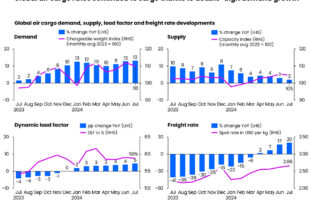
And crucially, on supply side there is the massive influx of aircraft, primarily wide-body freighters with such high belly capacity they’ve been called ‘hidden’ or ‘invisible’ freighters. “When you take an old B747 passenger aircraft off a route and you throw on a brand new B777-300ER, the capacity that you’ve added especially if it’s a daily flight, is a hidden freighter you’ve thrown on that route.”
Indeed as Nick Rhodes, director of cargo at Cathay Pacific points out, the new passenger aircraft are almost like the old Combis – “you can get almost 25 tonnes on a B777 or A350 in the future. You’ve got a huge space, you buy the aircraft and you’ve got to use the space,” he says.
This type of capacity expansion is largely unintended and the result of forward planning four or five years earlier Mahjoubian adds. Similarly on the freighter side. “You ordered those B747-8Fs five years ago and oh boy, here they come now!”
A great deal of this widebody passenger belly capacity is coming from the Middle East carriers who have made record aircraft orders to support their surging passenger business. But as Mahjoubian notes, at the end of the day “it’s still adding cargo capacity.”
“Hopefully we will see a correction somewhere,” he says. “Either we’ll see increasing demand because the next thing will happen, or we’ll see a significant amount of capacity removed from the market – either a combination carrier deciding freighters are not for them, or an all cargo carrier exiting the business.”
Agreeing with this sentiment Cathay’s Rhodes highlights the extreme difficulty in making a return on assets in the current market. “Something needs to change if we are to continue – I am optimistic in the long term that economies will come back, it’s cyclical and air cargo companies will lead the rebound,” he affirms.
“But, I think there will be a correction. I also think that during this sustained downturn there will be casualties. Some capacity will come out of the market – it has to happen and that will be freighters.
“Combination carriers like Cathay have to look very carefully at the number of freighters we operate on top of the passenger bellies. Our projections are a little more conservative in 2013 than they were in 2010 [when Cathay placed it original B777F orders]. “The only option is to park freighters and sit it out – it is a tough market in the short term, but in the longer term I’m more optimistic,” he says.
Paradigm shift? For AF-KLM’s Kunen the rising tide of belly capacity resulting from the surging new widebody fleet is “definitely creating less of a need to have freighters in addition to belly capacity for a combination carrier.”
But he adds the need is still there and in the longer term he doesn’t think many combination carriers will go to the model that Delta and other carriers like United have adopted, as a belly-only cargo carrier. “It can work but not everybody is in a position to have enough belly hold capacity to be offering the whole range of products to customers. So I think indeed there will be a new balance, but I don’t think the freighters will go away.”
In agreement, Rhodes highlights the traditional model for combination carriers. “The priority for a combination carrier is you’ve always got to fill the belly if you can and then you make your freighter schedule around that.”
As a combination carrier there is always a role for a freighter, he says. If a carrier decides it needs two or three freighters then it needs to ask the question whether to use ACMI because it may be more economical to use a contract provider, he says. On the other hand if it needs 10 or 20 freighters then it might be better to own them.
“We will be combination carrier for the long term, but we are evaluating how many freighters we need and whether we want to own them,” he adds. But while freighters may have a secure place in the air cargo industry going forward, what of the all-cargo carriers that don’t have the flexibility and economic advantages of marginal cost belly capacity.
For Wolfgang Meier, executive VP, AirBridgeCargo, operating an all maindeck fleet offers the ability to offer more tailored services that offer better scheduling for customers. “I still do see the need for all-cargo carriers, not just because I represent one, but I’m 30 years in the business and all-cargo carriers design schedules as per customer’s requirements, not because of the passenger side. We design schedules that fit into the supply chains of our customers, which is the forwarding community. This is something that has to have value in the future,” he says.
“Different horses for different courses,” says another maindeck proponent, Kersti Krepp, VP sales & marketing Asia Pacific at Polar Air Cargo. “Very simply there is a different customer that will use belly, a different customer that needs maindeck. At end of the day 60 per cent of all cargo rides on all-cargo aircraft, so there is a future for all cargo,” she says.
But Rhodes is not entirely convinced. Looking at the different categories he says the integrators are here to stay, particularly with people shopping online. “ACMI is a very robust model for people who want to contract more capacity. The belly only carriers I think obviously most are here more by default than by design, and combination carriers of course will be here in the future – it’s just a question of how many freighters you need to supplement the belly. All cargo operators will be more challenging – it’s a question of whether they can fill special need like heavy lift etc.”