


• Skip to main content
  • Skip to primary sidebar

Ad – Bottom Content

Payload Asia

After April passenger demand trough, first signals of uptick

Payload Asia

  • Home
  • Latest News
  • Channels 
    • Carriers
    • Aircraft Manufacturers
    • Airports
    • Courier & Mail
    • Freight Forwarders
    • Express
    • Ground Handling & Cargo Terminals
    • Logistics
  • 12th Payload Asia Awards
    • About
    • Categories
    • 11th Payload Asia Awards
    • 10th Payload Asia Awards
    • 9th Payload Asia Awards
    • Awards Gallery
  • Subscribe
  • Advertise
  • More 
    • Event Calendar
    • Directory
    • Contact Us
Share

Leaderboard

After April passenger demand trough, first signals of uptick

June 8, 2020 by PLA Editor

Chuttersnap/Unsplash

Chuttersnap/Unsplash

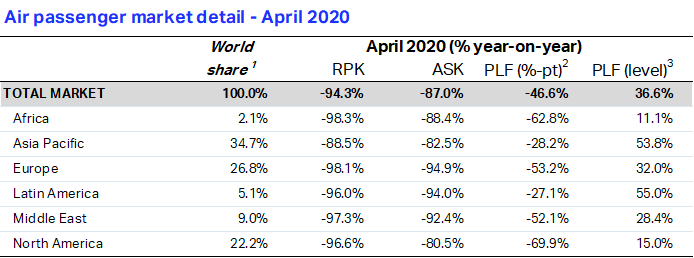
The International Air Transport Association (IATA) announced that demand for air services is beginning to recover after hitting bottom in April. Passenger demand in April (measured in revenue passenger kilometers or RPKs), plunged 94.3 percent compared to April 2019, as the COVID-19-related travel restrictions virtually shut down domestic and international air travel. This is a rate of decline never seen in the history of IATA’s traffic series, which dates back to 1990.

More recently, figures show that daily flight totals rose 30 percent between the low point on 21 April and 27 May. This is primarily in domestic operations and off of a very low base (5.7 percent of 2019 demand). While this uptick is not significant to the global dimension of the air transport industry, it does suggest that the industry has seen the bottom of the crisis, provided there is no recurrence. In addition, it is the very first signal of aviation beginning the likely long process of re-establishing connectivity.

“April was a disaster for aviation as air travel almost entirely stopped. But April may also represent the nadir of the crisis. Flight numbers are increasing. Countries are beginning to lift mobility restrictions. And business confidence is showing improvement in key markets such as China, Germany, and the US. These are positive signs as we start to rebuild the industry from a stand-still. The initial green shoots will take time—possibly years—to mature,” said Alexandre de Juniac, IATA’s Director General and CEO.

IATA calculated that by the first week of April, governments in 75% of the markets tracked by IATA completely banned entry, while an additional 19% had limited travel restrictions or compulsory quarantine requirements for international arrivals. The initial flight increases have been concentrated in domestic markets. Data from late May show that flight levels in the Republic of Korea, China, and Vietnam have risen to a point now just 22-28% lower than a year earlier. Searches for air travel on Google also were up 25% by the end of May compared to the April low, although that’s a rise from a very low base and still 60% lower than at the start of the year.
Courtesy of IATA

International passenger markets

April international passenger demand collapsed 98.4% compared to April 2019, a deterioration from the 58.1% decline recorded in March. Capacity fell 95.1%, and load factor plunged 55.3 percentage points to 27.5%.

Asia-Pacific airlines’ April traffic plummeted 98.0% compared to the year-ago period, worsened from a 70.2% drop in March. Capacity fell 94.9% and load factor shrank 49.9 percentage points to 31.3%.

European carriers’ April demand toppled 99.0%, a sharp decline from the 53.8% decline in March. Capacity dropped 97% and load factor shrank by 58 percentage points to 27.7%.

Middle Eastern airlines posted a 97.3% traffic contraction for April, compared with a 50.3% demand drop in March. Capacity collapsed 92.3%, and load factor crumbled to 27.9%, down 52.9% percentage points compared to the year-ago period.

North American carriers had a 98.3% traffic decline in April widened from a 54.7% decline in March. Capacity fell 94.4%, and load factor dropped 57.2 percentage points to 25.7%.

Latin American airlines experienced a 98.3% demand drop in April compared to the same month last year, from a 45.9% drop in March. Capacity fell 97.0% and load factor fell 34.5 percentage points to 48.1%, highest among the regions.

African airlines’ traffic sank 98.7% in April, nearly twice as bad as the 49.8% demand drop in March. Capacity contracted 87.7%, and load factor dived 65.3 percentage points to just 7.7% of seats filled, lowest among regions.

Domestic passenger markets

Domestic traffic fell 86.9% in April, with the steepest declines registered in Australia (-96.8 percent), Brazil (-93.1 percent), and the US (-95.7 percent). This was a sharp deterioration compared to a 51.0 percent decline in March. Domestic capacity fell 72.1 percent and load factor dropped 44.3 percentage points to 39.5 percent.

Courtesy of IATA

China’s carriers posted a 66.6 percent year-on-year decline in traffic in April, little changed from a 68.7% decline in March but an improvement from the 85 percent decline in February.Russian airlines’ domestic traffic fell 82.7 percent in April compared to April 2019. The slower shrinkage compared to the other markets is attributable to the later timing of the outbreaks in the country.

The bottom line

“For aviation, April was our cruelest month. Governments had to take drastic action to slow the pandemic. But that has come with the economic cost of a traumatic global recession. Airlines will be key to economic recovery. It is vital that the aviation industry is ready with bio-safety measures that passengers and air transport workers have confidence in. That’s why the speedy implementation of the International Civil Aviation Organization’s (ICAO) global guidelines for safely re-starting aviation is the top priority,” said de Juniac.

The ICAO Council’s “Takeoff: Guidance for Air Travel through the COVID-19 Public Health Crisis” is the authoritative and comprehensive framework of risk-based temporary measures for air transport operations during the COVID-19 crisis. These were developed through broad-based consultations with governments, the World Health Organization, and with key advice from aviation industry groups including IATA, Airports Council International (ACI World), the Civil Air Navigation Services Organization (CANSO), and the International Coordinating Council of Aerospace Industries Associations (ICCAIA).

“We fully support its recommendations and look forward to working with governments for a well-coordinated implementation. The world cannot afford to delay,” said de Juniac.


Other Topics: Air & Cargo Services, air cargo, Air Cargo Asia, air cargo freight, Air Forwarding, air freight, Air Freight Asia, Air Freight Logistics, air freighter, air freighting, Air Logistics Asia, Air Shipping Asia, airlines cargo, airways cargo, asia cargo news, cargo aviation, Covid-19, IATA, ICAO, passenger markets, travel restrictions

Related Articles

  • iata logoAir cargo resilience continues: August demand up 4.1%, says IATA
  • iata logoIATA study confirms that SAF technology rollout is main bottleneck to net zero, not feedstock availability
  • Logistaas expands automation capabilities to include new courier tracking and IATA file reading tools
  • iata logoIATA appoints Thomas Reynaert to lead global advocacy
  • ICAO DGCA for Asia and Pacific region encourages States to take steps for implementation of ACI Asia-Pacific & Middle East’s recommendations
  • Singapore hosts inaugural ICAO Asia-Pacific Regional Training Symposium

Ad – After Content

Primary Sidebar

Trending News

  • CAICargoAi Unveils CargoMART Interline, revolutionising… CargoAi is proud to announce the launch of CargoMART Interline,…
  • lufthansa cargoLufthansa Cargo launches development of innovative… Lufthansa Cargo is developing a new type of virtual reality…
  • cce groupCCE Group and Emirates sign MoU to expand long-term… CCE Group and Emirates have signed a Memorandum of Understanding to explore expanded…
  • ceva logisticsCEVA Logistics reinvents healthcare cold chain in Asia From life-saving vaccines to sensitive biologics, healthcare logistics demands precision,…
  • From L to R – Christopher Lim, Praveen Gregory, Bjoern SchoonDHL Global Forwarding announces strategic leadership… DHL Global Forwarding, the freight specialist arm of DHL Group,…
  • Saudia Cargo_Payload Asia 2025Saudia Cargo named ‘Best E-Commerce Carrier –… Saudia Cargo, the leading air cargo carrier in the Middle…
  • caasCAAS sets up Singapore Sustainable Aviation Fuel… The Civil Aviation Authority of Singapore (CAAS) has set up…

Payload Asia Awards

Subscribe To
Our Newsletter


Payload Asia continues to be the authoritative source for informative, accurate and up-to-date news and information on the air cargo industry and related sectors.

With its updated and refreshed look the online edition continues to provide high quality coverage on the Asia-Pacific, India-Middle East, Europe-CIS, North & South America and Africa air cargo markets.

© 2025 Harvest Information. All rights reserved. Privacy Policy

Partner Sites : Asia Food Journal and Television Asia Plus .

We use cookies and similar technologies to improve your browsing experience.
Continuing to use this site means you agree to our use of cookies. I agreeRead More
Privacy & Cookies Policy

Privacy Overview

This website uses cookies to improve your experience while you navigate through the website. Out of these cookies, the cookies that are categorized as necessary are stored on your browser as they are essential for the working of basic functionalities of the website. We also use third-party cookies that help us analyze and understand how you use this website. These cookies will be stored in your browser only with your consent. You also have the option to opt-out of these cookies. But opting out of some of these cookies may have an effect on your browsing experience.
Necessary
Always Enabled

Necessary cookies are absolutely essential for the website to function properly. This category only includes cookies that ensures basic functionalities and security features of the website. These cookies do not store any personal information.

Non Necessary

Any cookies that may not be particularly necessary for the website to function and is used specifically to collect user personal data via analytics, ads, other embedded contents are termed as non-necessary cookies. It is mandatory to procure user consent prior to running these cookies on your website.

Analytics

Analytical cookies are used to understand how visitors interact with the website. These cookies help provide information on metrics the number of visitors, bounce rate, traffic source, etc.

Performance

Performance cookies are used to understand and analyze the key performance indexes of the website which helps in delivering a better user experience for the visitors.

Advertisement

Advertisement cookies are used to provide visitors with relevant ads and marketing campaigns. These cookies track visitors across websites and collect information to provide customized ads.

Save & Accept

Stay Updated!

Subscribe now to receive the latest news, updates, and exclusive insights. Don’t miss out!


By submitting this form, you consent to receive marketing emails from Payload Asia. You can revoke your consent to receive emails at any time by using the SafeUnsubscribe® link, found at the bottom of every email.

Disclaimer: Translations on this website are automated using Google Translate. While we strive for accuracy, please be cautious, as machine translations may contain errors. For critical or sensitive content, consider seeking professional human translation. We are not liable for any reliance on the translated content.

1