


The Clark International Airport Corporation (CIAC) is making strategic moves to position the Clark Civil Aviation Complex (CAC) as the Philippines’ next major cargo and logistics hub. Backed by a sweeping redevelopment of the 2,367-hectare estate, CIAC is accelerating infrastructure, estate management, and policy reform efforts to meet surging regional demand.

“CIAC has re-strategised and refocused on estate management and airport infrastructure development to support CRK and transform the 2,367-hectare Clark Civil Aviation Complex into the Clark Aviation Capital,” says CIAC President and CEO Joseph P. Alcazar.


New direction, renewed focus
In the first five months of 2025, Clark International Airport (CRK) doubled its cargo throughput year-on-year, handling over 35,900 tonnes across more than 2,500 flights. Long positioned as a strategic alternative to the congested gateways of Metro Manila, CRK is now leveraging its prime location, expansive aviation estate, and upgraded infrastructure to support CIAC’s logistics vision.
In 2024, the agency formalised a new corporate direction centred on infrastructure, connectivity, and logistics. “CIAC is actively marketing the CAC as an ideal location for air cargo, logistics, and light manufacturing industries,” Alcazar adds.
Geography and policy: Clark’s key advantages
Situated in Central Luzon, the CAC benefits from direct access to major expressways, seaports, and the Metro Manila market—enabling fast cargo movement with multimodal options.
“The CAC, as the largest aviation complex in the Philippines and one of the few freeport zones with an international airport, offers locators unique operational and tax advantages,” Alcazar notes.
Clark’s proximity to Luzon’s industrial corridors and its uncongested airspace make it ideal for time-sensitive cargo, including e-commerce shipments and Maintenance, Repair, and Overhaul (MRO) operations. The airport is accessible via the North Luzon Expressway (NLEX), Subic–Clark–Tarlac Expressway (SCTEX), and Tarlac–Pangasinan–La Union Expressway (TPLEX).
Additionally, CRK is part of two major rail infrastructure projects:
- The North–South Commuter Railway (NSCR), which will provide passenger access to and from Metro Manila and Laguna, with operations expected by 2028.
- The Subic–Clark–Manila–Batangas (SCMB) Railway Project will enable freight movement across major logistics hubs and seaports.
To further enhance its attractiveness, Clark Freeport Zone locators benefit from tax holidays, enhanced deductions, and duty exemptions under the CREATE MORE Act, administered through the Strategic Investment Priority Plan (SIPP) of the Board of Investments.
Strengthening links across Luzon and beyond
To support its growing logistics role, Clark is investing in long-term infrastructure that enhances access to key economic zones and trade corridors.
“Future rail infrastructure will significantly improve multimodal connectivity,” Alcazar says. “The SCMB Railway will directly connect CRK to seaports and economic zones in Subic, Manila, and Batangas.”
Clark is also part of the Luzon Economic Corridor (LEC), a trilateral initiative under U.S.–Japan–Philippines cooperation, which seeks to strengthen industrial and infrastructure ties across Subic Bay, Clark, Manila, and Batangas.
“This cooperation is expected to catalyse investments in logistics and manufacturing at Clark,” Alcazar adds.
Cargo volumes climb as connectivity expands
“Cargo volume at Clark has increased by 100 percent in the first five months of 2025, handling 35,903 tons and 2,522 flights—a 45 percent year-over-year increase,” Alcazar shares. This builds on a 32 percent increase in 2024, when CRK handled 58,459 tons, according to LIPAD, the airport’s private operator.
The surge follows the July 2025 launch of cargo flights between Shenzhen and Clark by Shandong Airlines, joining other China-based carriers such as YTO Cargo Airlines, China Postal Airlines, Central Airlines, Jiangsu Jingdong Cargo Airlines, and Tianjin Air Cargo.
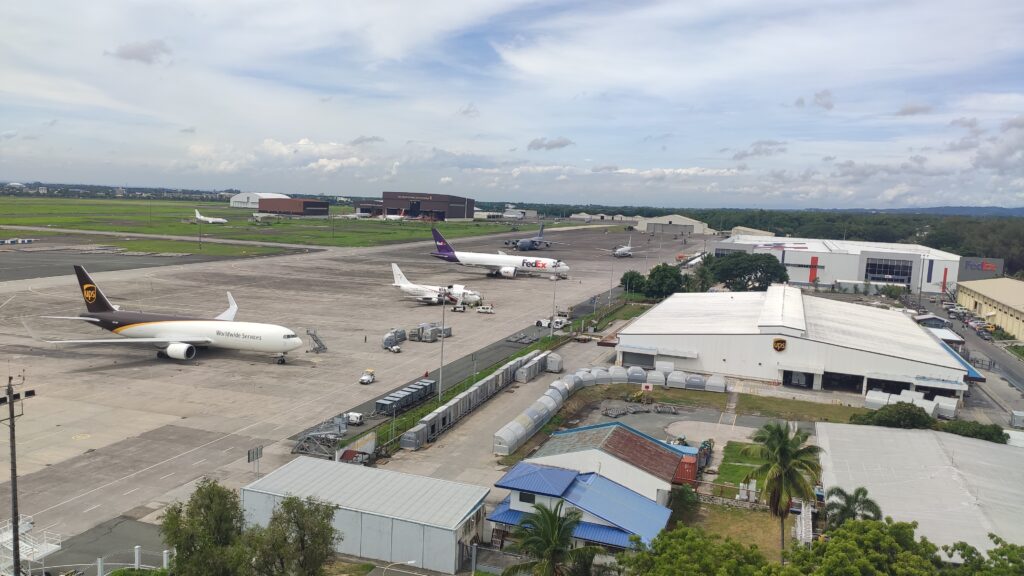
FedEx, one of CRK’s major operators, signed an agreement in July 2024 to expand its facility at the airport.
“This move enhances the region’s logistics capacity and signals growing investor confidence,” Alcazar notes.
Infrastructure builds and future hubs
Supporting this momentum is a pipeline of infrastructure projects led by CIAC. These include a new air traffic control tower, upgraded airfield lighting systems, and radar installations—all essential for safe and efficient cargo operations.
A key development is the proposed 70-hectare food trading and logistics hub near the airport, expected to be completed by 2028. The hub will support warehousing, processing, and international shipment.
Building capabilities for specialised cargo
CIAC is also looking at future growth areas, such as temperature-sensitive cargo and e-commerce logistics.
“In 2024, CIAC signed a Memorandum of Understanding with Philippine Pharma Procurement, Inc. to explore developing pharmaceutical logistics capabilities within the complex, including cold chain and warehousing support for medical and pharmaceutical goods,” Alcazar says.
These plans will complement the Clark National Food Hub, a 64-hectare agri-industrial estate within the CAC. “The Food Hub will feature cold storage facilities, consolidation centres, and logistics infrastructure to support the movement of perishables and temperature-sensitive agricultural commodities,” he adds.
CIAC is also exploring digital fulfilment solutions to enhance e-commerce and last-mile logistics across the estate.
Enhancing resilience and multimodal mobility
As part of its long-term planning, CIAC is evaluating new infrastructure aimed at resilience and disaster readiness.
“CIAC, in coordination with its parent company, the Bases Conversion and Development Authority (BCDA), is studying the development of a parallel runway within the Clark Civil Aviation Complex to serve as a contingency airstrip in the event the primary runway becomes inoperable due to emergencies or natural disasters,” Alcazar says.
CIAC is also advancing plans for a Multimodal Mobility Hub, envisioned as a compact, connected space that integrates various transport modes while improving urban access and logistics efficiency.
Governance, services, and sustainability
Though CIAC does not directly operate cargo services, it plays a crucial support role for estate locators and cargo operators.
“We are strengthening our estate management services by streamlining lease transactions and other processes through GIS-based property management technology,” Alcazar explains. “CIAC also complies with its ARTA commitment relative to the process cycle time of its clients’ transactions.”
Policy reforms are helping to accelerate infrastructure development. The Public-Private Partnership (PPP) Code institutionalises best practices for private-sector participation and offers a transparent framework for implementing major projects.
“This allows us to pursue critical projects—such as terminal upgrades and logistics parks—under a more flexible, investor-friendly framework,” he adds.
Sustainability remains central to CIAC’s long-term outlook. “CIAC actively supports initiatives that promote sustainable aviation, including efforts to attract locators engaged in Sustainable Aviation Fuel (SAF) production, storage, or distribution within the aviation complex,” Alcazar notes.
Infrastructure planning across Clark Aviation Capital incorporates green building standards, efficient land use, and transport connectivity designed to lower the carbon footprint of logistics operations.
This story was first published in the July-August 2025 issue of Payload Asia.