


Global supply chains have always been complex, but today they face near-constant volatility. Shifting trade routes, evolving regulations, geopolitical tensions, and climate disruptions have made uncertainty the new normal. According to McKinsey, supply chain disruptions lasting more than a month now occur every 3.7 years on average and can erode up to 45% of a company’s annual profits over a decade. At the same time, the bar is rising on the customer side: speed, transparency, and personalisation are no longer nice-to-haves but essentials.
The real question is not if disruption will strike, but how swiftly and effectively your supply chain can respond. Achieving this demands moving beyond fragmented, traditional logistics toward hyperconnected, digitally intelligent networks. When integrated end-to-end, these systems empower businesses, particularly small and medium enterprises (SMEs), to detect risks in real time, stabilise operations, cut avoidable costs, and reliably meet escalating customer expectations. Resilience today is built less on buffers and more on connectivity, linking data, decisions, and delivery end to end.
From silos to seamless ecosystems
For decades, procurement, manufacturing, warehousing, transportation, and last-mile delivery operated in isolation. Digital intelligence is dismantling these silos. Once every stakeholder, asset, and data point is connected, coordination becomes faster and more consistent, friction drops, inventory aligns to real demand, lead times stabilise, and variability shrinks.
The result is a more predictable supply chain: steadier lead times, less variability, and more flexibility when conditions change.

From reactive to predictive orchestration
Digital tools transform planning from reaction to foresight. Machine learning now integrates historical data with live inputs, from market shifts and weather patterns to geopolitical events and demand signals, generating accurate, forward-looking forecasts. Companies can proactively allocate capacity months ahead and test contingencies through sophisticated scenario modelling, for example, simulating port closures, demand surges, or extreme weather.
Therefore, when disruptions occur, hyperconnected networks can enable rapid, often autonomous responses: rerouting shipments, switching modes, selecting alternate hubs, or rebalancing resources, all informed by real-time, data-driven insights. This minimises risks and ensures continuity. However, prediction and orchestration only work when organisations can see what’s happening across the network. Even the best predictive models rely on one foundational element: unparalleled visibility.
Operational transparency to prevent disruptions
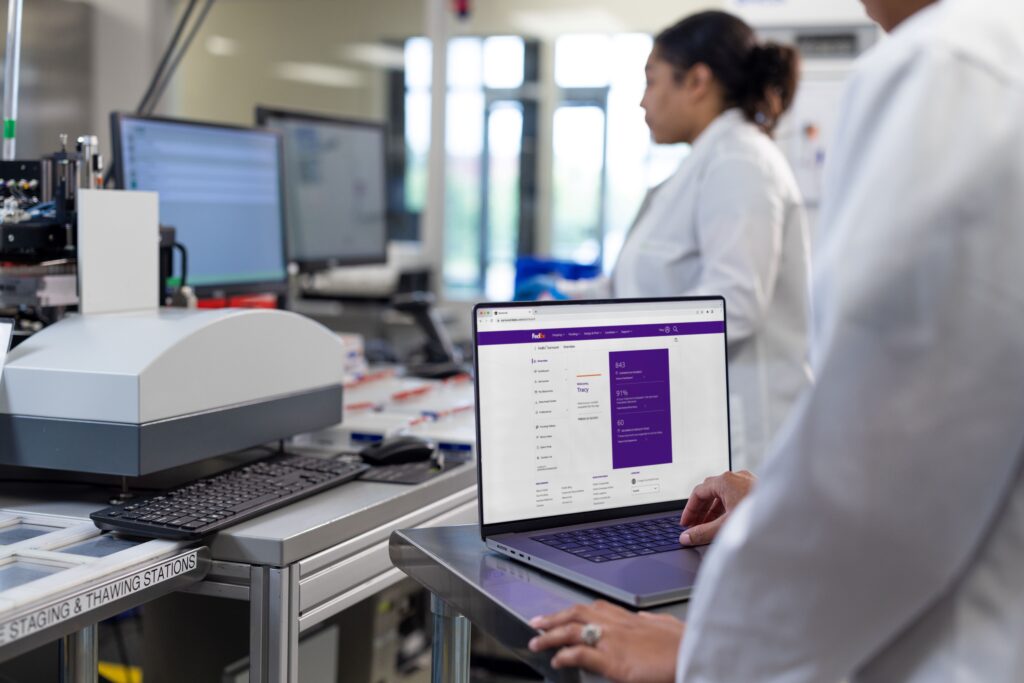
Resilience requires more than prediction. It demands granular, real-time insight. Modern tracking goes far beyond a simple GPS marker. Advanced IoT sensors now capture precise data on location, temperature, humidity, shock, and even light exposure, enabling early interventions. For instance, teams can correct temperature excursions in pharmaceuticals or prevent damage to high-value electronics before issues escalate. This shift from tracking to sensing turns visibility into action.
Solutions like FedEx Surround Monitoring and Intervention enable this evolution, pairing advanced sensors with predictive dashboards for proactive monitoring of critical shipments. In one global semiconductor implementation, a centralised control tower unified sensor data, scan events, and multiple systems into a single real-time view. This reduced manual handoffs and protected sensitive cargo from environmental threats, delivering end-to-end oversight. The outcome is not only fewer exceptions, but faster recovery when exceptions do occur.
Experience as a competitive edge
In today’s on-demand world, customers, B2B and B2C alike, expect seamless digital experiences. Hyperconnected logistics make this possible, optimising inventory placement, transport modes, routes, and delivery windows. Extending intelligence across ordering, packing, shipping, delivery, returns, and even carbon tracking turns reliability into a differentiator.
Companies that deliver consistent predictability build lasting trust and loyalty. Over time, that reliability becomes a brand advantage, not just an operational metric.
These capabilities are especially vital in high-growth, high-variability regions like the Asia Pacific. Here, complexity is the baseline, and responsiveness determines who wins.
Asia Pacific: Navigating complexity for opportunity
The region combines rapid expansion with intricate challenges: diverse regulations, evolving trade lanes, and booming e-commerce. Deep digital integration helps businesses confidently manage fragmented markets, streamline documentation, and harness multimodal networks. For SMEs scaling up and multinationals expanding, these tools level the playing field, opening doors to new customers and trade corridors. When logistics becomes easier to navigate, growth becomes easier to pursue.
Asia Pacific makes the case clear: when complexity is constant, resilience becomes a growth strategy, not a contingency plan.
From resilience to strategic advantage
Hyperconnected supply chains don’t just withstand shocks. They drive growth. Advanced forecasting frees working capital by reducing excess inventory. Swift exception handling safeguards revenue and relationships. Integrated operations drive down costs while elevating service. In effect, resilience becomes a multiplier: it protects downside while unlocking upside.
When connected ecosystems, predictive orchestration, real-time transparency, and superior experiences converge, backed by deep logistics expertise, the supply chain becomes a powerful growth engine: adaptive, intelligent, and ready to thrive amid constant complexity.
In an era where volatility is constant, reimagining resilience isn’t optional. It is the path to sustained advantage.
This story was first published in the November-December 2025 issue of Payload Asia.