
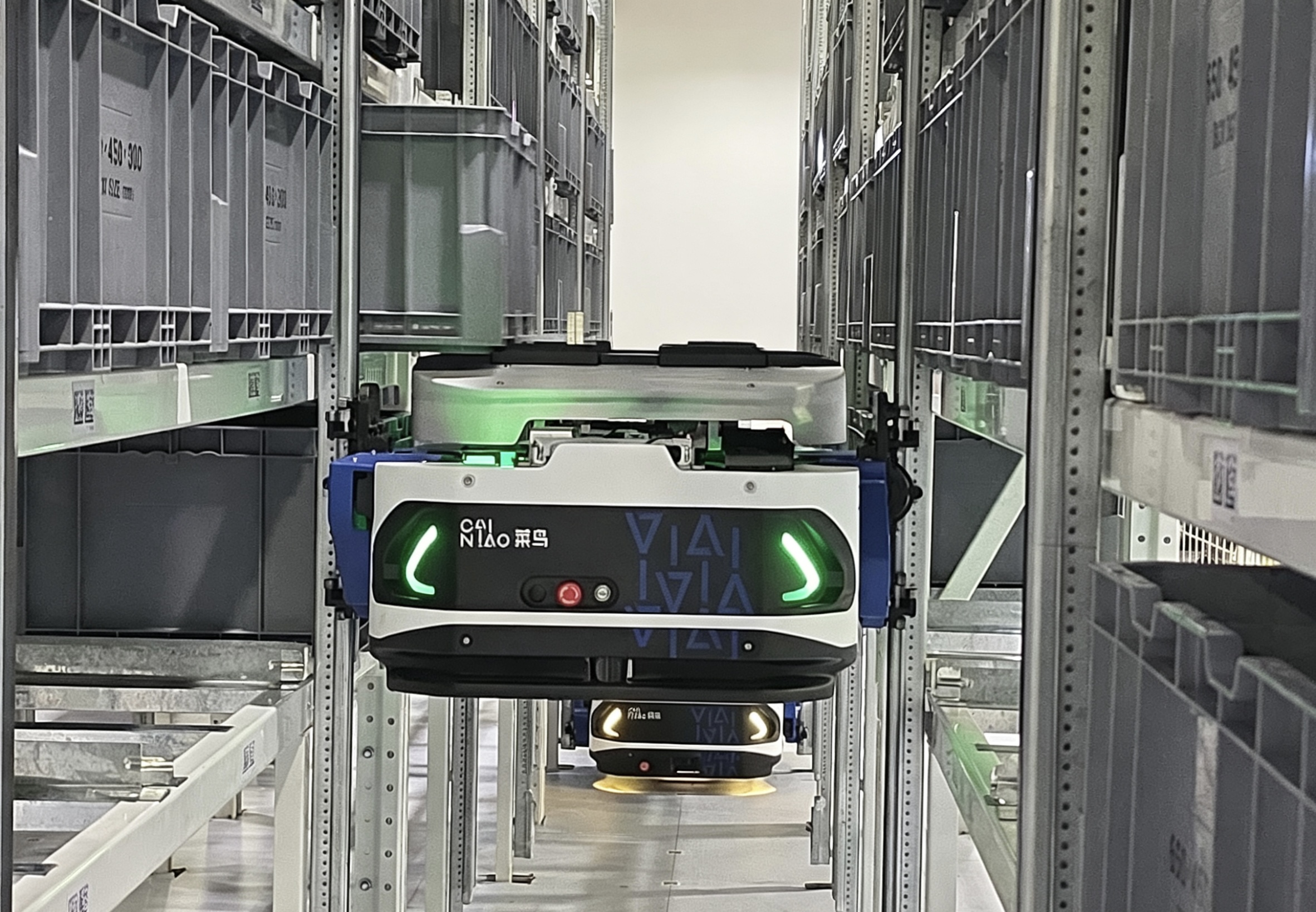
Cainiao’s climbing robot system, ZeeBot, has secured a number of external contracts, while four to five large-scale internal projects are set to go live this year, underscoring the company’s growing momentum in warehouse automation.
“Customer feedback has been positive so far, and our contract value this year has grown much faster than that of peers at a similar stage,” said Bi Jianghua, Vice President of Cainiao and General Manager of its Logistics Technology division.
Cainiao’s climbing robot rollout is expanding rapidly across global markets. This year, the company plans to launch projects in the Netherlands and Spain, both of which will be larger in scale than its Dongguan warehouse, where ZeeBot is already in operation. In Guangzhou, three additional projects are under development, while a project in Hong Kong is currently in the delivery stage. Cainiao is also in the solution-design phase for projects in the U.S. and Canada, expects to confirm a project in Japan soon, and is in discussions over potential opportunities in the Middle East.

Launched last month, ZeeBot operates at 4 meters per second on flat surfaces and reaches five-story-high shelves in 10 seconds. The system increases storage density by 40 percent compared to conventional automated warehouses.
All core components are developed and manufactured in-house, with final assembly conducted at Cainiao’s own facilities. The system’s modular architecture is intended to accelerate deployment and improve scalability across different warehouse environments.
Cainiao is offering ZeeBot through two commercial models: direct delivery of complete turnkey solutions, or partnership-based deployment with global integrators, where Cainiao provides the core hardware and software while the integrator handles system design and implementation.
Bi said purchasing decisions in warehouse automation are increasingly shaped by long-term operating value rather than upfront equipment cost.
“Most clients place greater emphasis on total operating cost, after-sales support, and regulatory compliance than on initial pricing,” he said. “Operational consistency, system reliability, and the ability to integrate with other warehouse hardware and software are becoming increasingly important. For supply chains operating at scale, that consistency is what ultimately delivers greater fulfilment certainty.”
Bi also outlined the evolution of tote robot systems through four stages. The first generation was the bin shuttle system, in which each warehouse level was equipped with a shuttle, and transfers were handled by lifts. While efficient, the model was expensive. The second generation was goods-to-person AGVs, which solved the transfer issue but were constrained by limited space utilisation. The third generation was the CTU model, or a large-and-small vehicle handoff system, in which larger robots operate in aisles to retrieve bins while smaller robots transport them on the floor. However, the system is bottlenecked by the slower speed of the larger robots, and the complexity of coordinating handoffs adds further operational burden. The fourth generation is the mini-load stacker solution, which is fast and relatively low-cost, but its “one aisle, one robot” structure means that a single unit failure can bring an entire aisle to a halt, limiting flexibility.
“By the time we developed the climbing robot generation, we saw it as the solution closest to the final form of the product,” Bi said.
Looking ahead, Cainiao expects the next generation of climbing robots to add three key capabilities: the ability to move freely on top of storage racks rather than staying floor-bound, integrated robotic arms for autonomous picking, and a self-recovery function that would allow one robot to assist another in case of failure.
The company also plans to develop its dedicated picking robots alongside the climbing system, with the goal of fully automating both putaway and retrieval to support round-the-clock unmanned warehouse operations.