



• Skip to main content
  • Skip to primary sidebar

Ad – Bottom Content

Payload Asia

Study: Humans are still the “integration layer” in freight operations despite AI expansion

Payload Asia

  • Home
  • Latest News
  • Channels 
    • Carriers
    • Aircraft Manufacturers
    • Airports
    • Courier & Mail
    • Freight Forwarders
    • Express
    • Ground Handling & Cargo Terminals
    • Logistics
  • 12th Payload Asia Awards
    • About
    • Categories
    • 11th Payload Asia Awards
    • 10th Payload Asia Awards
    • 9th Payload Asia Awards
    • Awards Gallery
  • Subscribe
  • Advertise
  • More 
    • Event Calendar
    • Directory
    • Contact Us
Share

Leaderboard

Study: Humans are still the “integration layer” in freight operations despite AI expansion

May 14, 2026 by PLA Editor


Despite years of investment in digital platforms and AI, freight operations still depend heavily on humans manually connecting disconnected systems, according to a new industry report released by Deep Current, a Germany-based AI company building the pre-operational data flow infrastructure layer for logistics.

“Many logistics organisations continue to operate in environments where workflows are fragmented and require a significant ‘human integration layer’ in between more than 5+ systems on average for a typical workflow.  Even in 2026, many tech platforms and AI models still depend on this human intervention to deliver results.” Shared Tamim Fannoush, Founder & CEO, Deep Current AS.

The report, Levers of Digital Sophistication, examines where logistics AI initiatives continue to break down operationally, despite growing pressure across the industry to scale automation, improve resilience and reduce execution delays.

The study indicates that a large share of the industry still struggles in the early stages of operational digitalisation and decision intelligence, where data does not flow seamlessly, and automation is not fully embedded into the first entry points of data feeding.

Where exactly does the  logistics operations break
With more than 24 months of project implementation samples studied, varying across mid and large-sized logistics sector implementation, we mapped the hot spots of friction that hinder AI integration.  The highest friction remains in data connectivity and workflow integration, where systems are still disconnected, and AI operates outside execution.
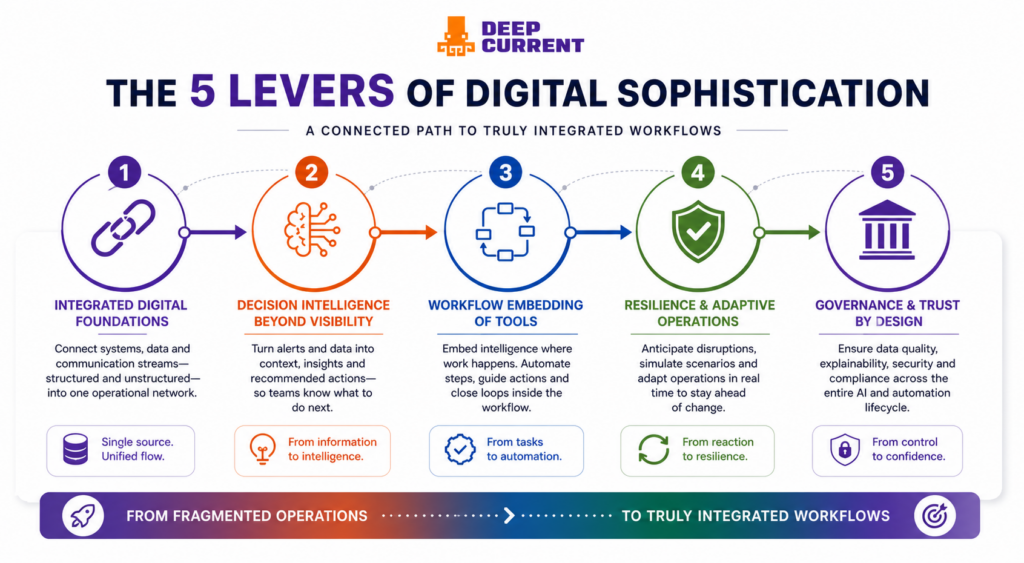
The report found:

  • 61% of logistics teams still depend on emails and spreadsheets for operational communication
  • 57% report shipment delays caused by document errors
  • Only 29% have implemented digital tools across core operational workflows
  • 47% cite legacy system integration as the biggest barrier to adoption

Additional operational analysis conducted by Deep Current also found that more than half of logistics operators still re-enter the same shipment data across multiple systems, while nearly half switch between five or more platforms to complete a single workflow.

According to the report, the problem is no longer visibility.

Most logistics organisations can now detect disruptions, delays and shipment exceptions in real time. The larger breakdown is happening at the execution layer, where operational teams still manually interpret, validate and move information across fragmented systems.

This gap between digital ambition and operational reality is where most transformation efforts stall.

The report identifies five operational levers shaping digital sophistication in logistics:

    • Integrated digital foundations
    • Decision intelligence beyond visibility
    • Workflow embedding of AI tools
    • Predictive resilience and scenario capability
    • Governance, skills and human-AI partnership

Together, they outline how organisations move from fragmented execution to truly integrated, AI-driven workflows. Each lever builds on the last, shifting operations from manual interpretation to structured data, from isolated tools to embedded intelligence, and from reactive processes to scalable, resilient systems.
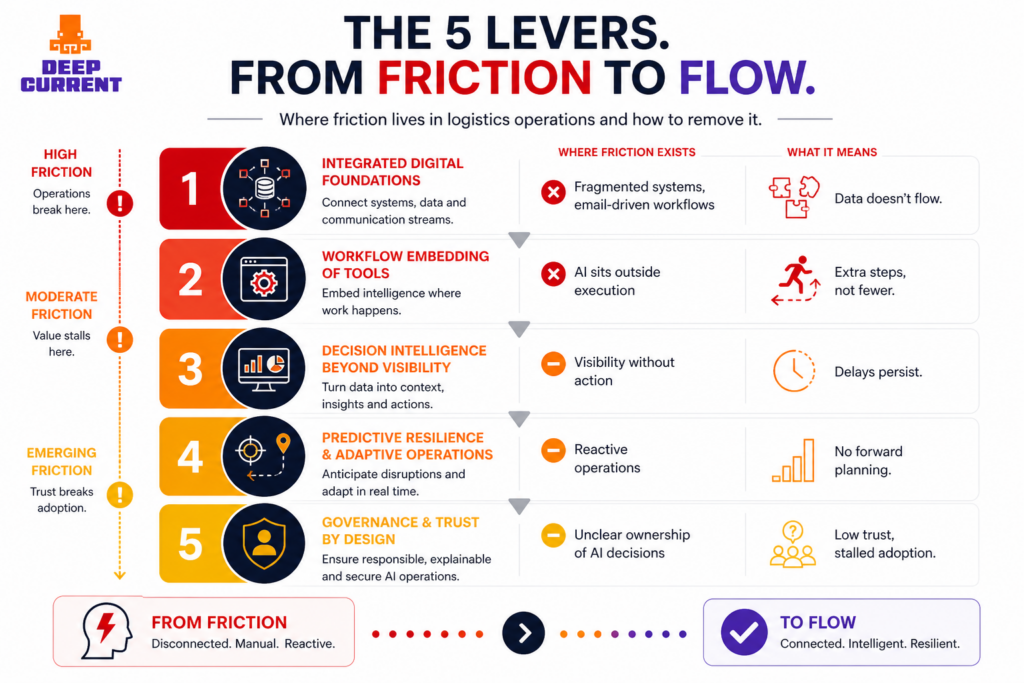
Deep Current argues that many AI initiatives continue to struggle because intelligence is layered on top of workflows rather than embedded directly inside them.

“As long as AI sits outside operational execution, teams still end up doing the integration work manually,” said Fannoush. “Copy-paste workflows, repeated validation, and fragmented communication continue to absorb enormous operational capacity across freight.”

The company positions this challenge as a “pre-operational intelligence” problem, where operational breakdowns often originate before execution even begins, at the point where information is created, shared and interpreted across systems.

Deep Current develops AI systems for logistics operations focused on structuring unstructured operational inputs, validating information across sources and enabling clean data flow across workflows. Its product suite includes tools for demand intake, document validation, data extraction and workflow intelligence.

Read the full report here.

Other Topics: air cargo network, air express, air freight services, air logistics, Asia Pacific air cargo, Asia Pacific air freight, Asia Pacific air logistics, Asia Pacific shipments, cargo flights, Deep Current, e-commerce logistics, express delivery, express logistics, international air shipments, international express delivery, transpacific air cargo, transpacific air freight

Related Articles

  • Saudia Cargo unveils ‘Reliable Solutions, Certified Excellence’ campaign to highlight specialised services across global supply chains
  • Vietnam Airlines appoints ECS Group as Cargo GSA in Korea, strengthening growth across key trade corridors
  • Kuehne+Nagel to reduce air freight emissions for Google Cloud shipments with sustainable aviation fuel
  • Cargolux partners with Cathay Technologies to bring state-of-the-art Electronic Flight Folder on board
  • hong kong international airportPassenger traffic at HKIA records double-digit growth in May
  • HAECO to form joint venture with Sun Group, Toyota Tsusho and Japan Airlines for new aircraft maintenance facility at Van Don International Airport

Ad – After Content

Primary Sidebar

Trending News

  • CAICargoAi Unveils CargoMART Interline, revolutionising… CargoAi is proud to announce the launch of CargoMART Interline,…
  • lufthansa cargoLufthansa Cargo launches development of innovative… Lufthansa Cargo is developing a new type of virtual reality…
  • cce groupCCE Group and Emirates sign MoU to expand long-term… CCE Group and Emirates have signed a Memorandum of Understanding to explore expanded…
  • ceva logisticsCEVA Logistics reinvents healthcare cold chain in Asia From life-saving vaccines to sensitive biologics, healthcare logistics demands precision,…
  • From L to R - Christopher Lim, Praveen Gregory, Bjoern SchoonDHL Global Forwarding announces strategic leadership… DHL Global Forwarding, the freight specialist arm of DHL Group,…
  • Hactl Executive Director–Information Services John Lee (left) received the ISO IEC 27001 2022 certification from SGS Hong Kong Limited Deputy Director, Products & Services Development Chris Yau (right).Hactl’s COSAC-Plus becomes the first Hong Kong… Hong Kong Air Cargo Terminals Limited (Hactl) – Hong Kong’s largest…
  • Saudia Cargo_Payload Asia 2025Saudia Cargo named ‘Best E-Commerce Carrier –… Saudia Cargo, the leading air cargo carrier in the Middle…

Payload Asia Awards

Subscribe To
Our Newsletter


Payload Asia continues to be the authoritative source for informative, accurate and up-to-date news and information on the air cargo industry and related sectors.

With its updated and refreshed look the online edition continues to provide high quality coverage on the Asia-Pacific, India-Middle East, Europe-CIS, North & South America and Africa air cargo markets.

© 2025 Harvest Information. All rights reserved. Privacy Policy

Partner Sites : Asia Food Journal and Television Asia Plus .

We use cookies and similar technologies to improve your browsing experience.
Continuing to use this site means you agree to our use of cookies. I agreeRead More
Privacy & Cookies Policy

Privacy Overview

This website uses cookies to improve your experience while you navigate through the website. Out of these cookies, the cookies that are categorized as necessary are stored on your browser as they are essential for the working of basic functionalities of the website. We also use third-party cookies that help us analyze and understand how you use this website. These cookies will be stored in your browser only with your consent. You also have the option to opt-out of these cookies. But opting out of some of these cookies may have an effect on your browsing experience.
Necessary
Always Enabled

Necessary cookies are absolutely essential for the website to function properly. This category only includes cookies that ensures basic functionalities and security features of the website. These cookies do not store any personal information.

Non Necessary

Any cookies that may not be particularly necessary for the website to function and is used specifically to collect user personal data via analytics, ads, other embedded contents are termed as non-necessary cookies. It is mandatory to procure user consent prior to running these cookies on your website.

Analytics

Analytical cookies are used to understand how visitors interact with the website. These cookies help provide information on metrics the number of visitors, bounce rate, traffic source, etc.

Performance

Performance cookies are used to understand and analyze the key performance indexes of the website which helps in delivering a better user experience for the visitors.

Advertisement

Advertisement cookies are used to provide visitors with relevant ads and marketing campaigns. These cookies track visitors across websites and collect information to provide customized ads.

Save & Accept

Stay Updated!

Subscribe now to receive the latest news, updates, and exclusive insights. Don’t miss out!


By submitting this form, you consent to receive marketing emails from Payload Asia. You can revoke your consent to receive emails at any time by using the SafeUnsubscribe® link, found at the bottom of every email.

Disclaimer: Translations on this website are automated using Google Translate. While we strive for accuracy, please be cautious, as machine translations may contain errors. For critical or sensitive content, consider seeking professional human translation. We are not liable for any reliance on the translated content.

1