
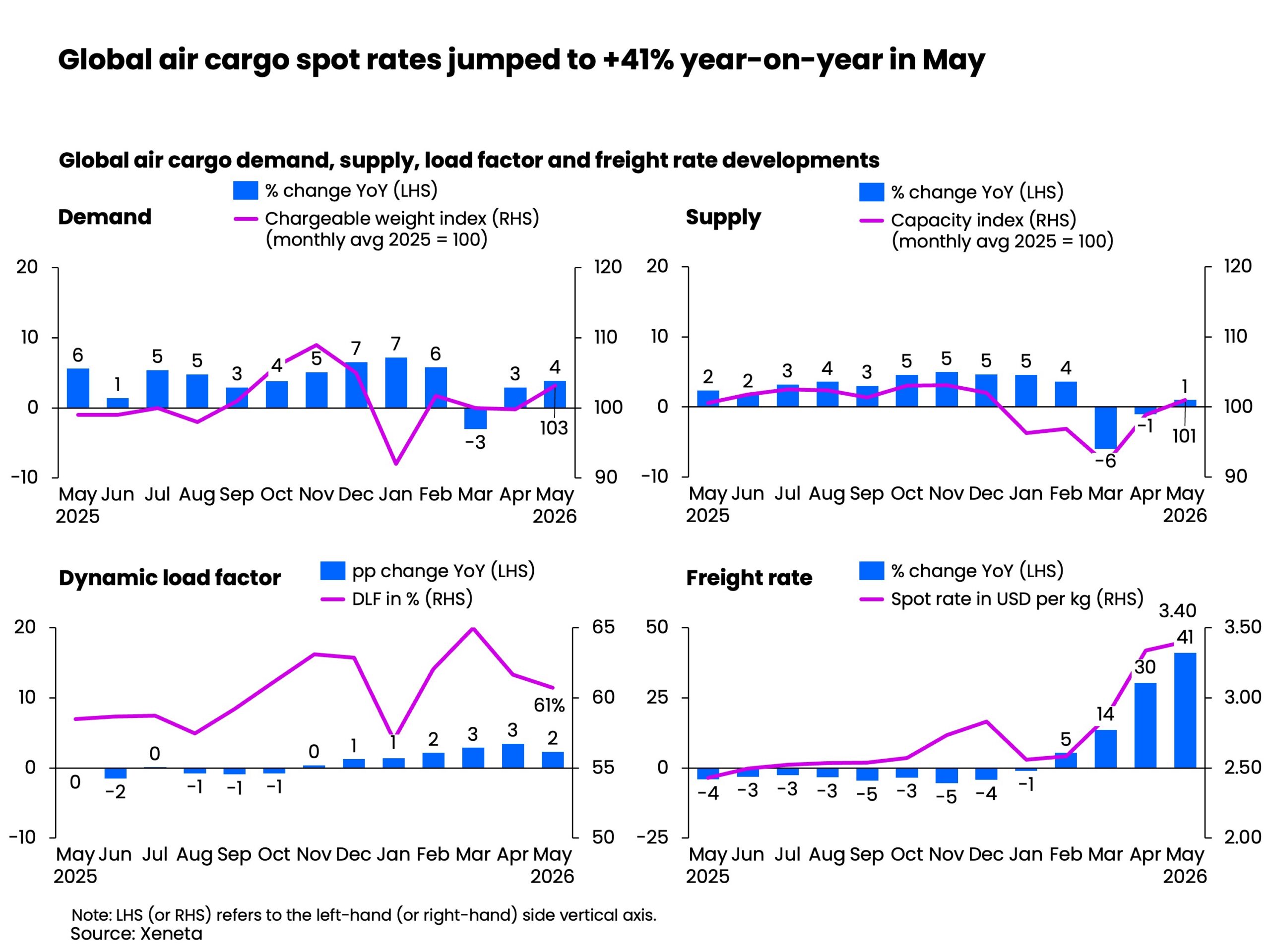
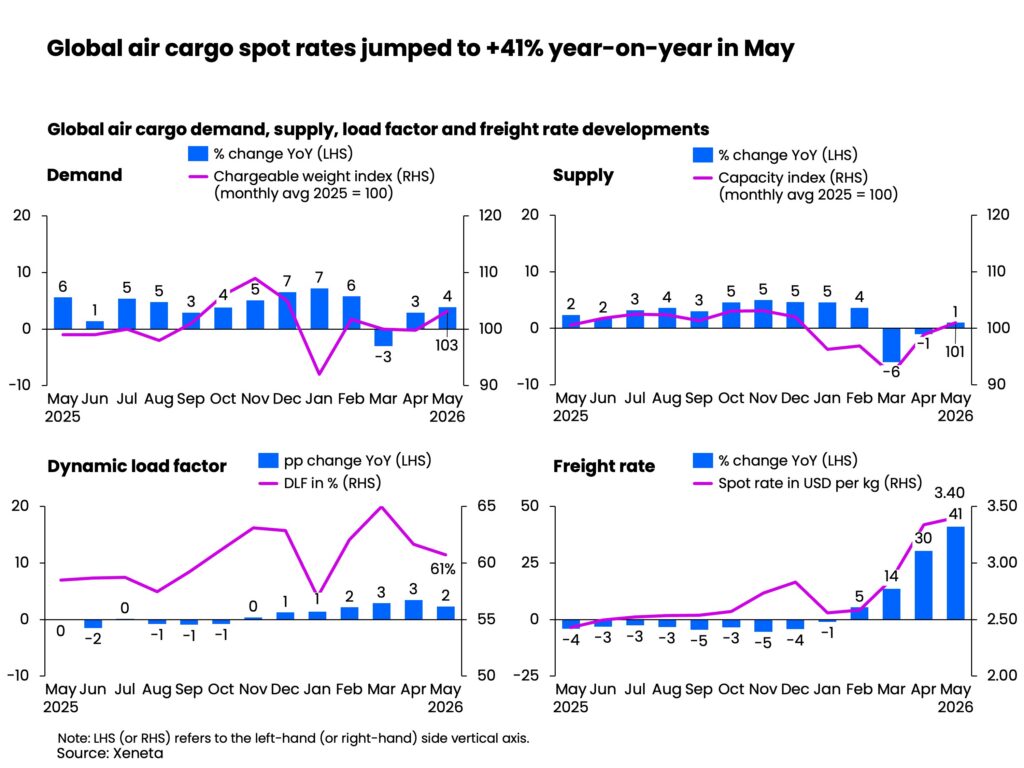
After hitting a three-year high in the previous month, global air cargo spot rates jumped up again in May, rising +41% year-on-year, but the pricing pressures on shippers may start to ease in June, according to industry analysts, Xeneta.
May’s average global spot rate of USD 3.40 per kg was driven by market fundamentals as global air cargo demand stayed resilient – slightly ahead of expectations – and outpaced supply, which continued to recover from disruption caused by the Middle East conflict, ending the month above last year’s capacity level by +1%. Demand grew +4% year-on-year in May, lifting the dynamic load factor two percentage points to 61%. Dynamic load factor is Xeneta’s measurement of capacity utilisation based on volume and weight of cargo flown alongside available capacity.
While acknowledging most shippers’ understanding that rates go up during global events like the current conflict between the U.S., Israel and Iran, Xeneta’s Chief Airfreight Officer, Niall van de Wouw, believes some relief may be on the way in June.
“A lot of the air cargo market statements we made in April hold true,” he said. “Shippers clearly have a sense of ‘here we go again’ in terms of rate volatility, but they are adjusting and buying time by temporarily accepting the surcharges that come with extending existing capacity contracts. This is because they’re not ready to make a longer-term commitment until there are clear signs the market is normalising.”
Shippers buying time for rates to fall
It’s a waiting game not all shippers are ready or able to play, however. Frontloading is already happening in the ocean freight market and could become a leading indicator of the action some shippers might follow with their airfreight volumes, he added.
“On the ocean side, we see some frontloading. In many cases, the shippers doing this are acting now because they expect energy to become more costly, so they are producing now in anticipation of higher costs later, as well as to avoid traditional peak season surges in rates. But they then must move and sell their goods, and this is at a time of higher transportation costs. So, what happens? Demand rises and rates go up. It’s self-inflicted on the ocean side, but the longer the current market operating conditions continue, we could see this seep over into the airfreight,” van de Wouw said.
But with Middle East carrier capacity returning to almost full-scale operations, van de Wouw believes a more likely short-term outcome will be lower global air freight rates in the weeks ahead.
“We are on record saying rates wouldn’t come down as fast as they went up, and that is the case,” he continued. “It takes a while for rates to adjust to the market situation, but I would not be surprised to see year-on-year spot rate comparisons decline in June, especially as there are not a lot of industry verticals that are booming at the moment.”
Rates showed signs of easing in May
Despite the overall rise in the global spot rate in May, the month did show some signs of air freight rates easing. Despite rising +22% year-on-year, long-term rates (valid for more than one month), which offer some insight into forward-looking pricing, eased after peaking at the end of April – a sign the market already considers the pricing peak has been reached.
Further easing of spot rate growth is expected to be driven by the northern hemisphere summer months, typically a slack season for air freight as peak passenger travel capacity is largely restored, although, once again, rate reductions are likely to lag the market by some weeks.
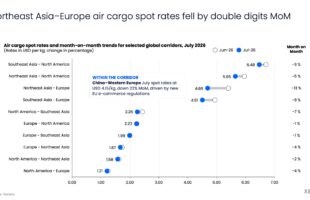
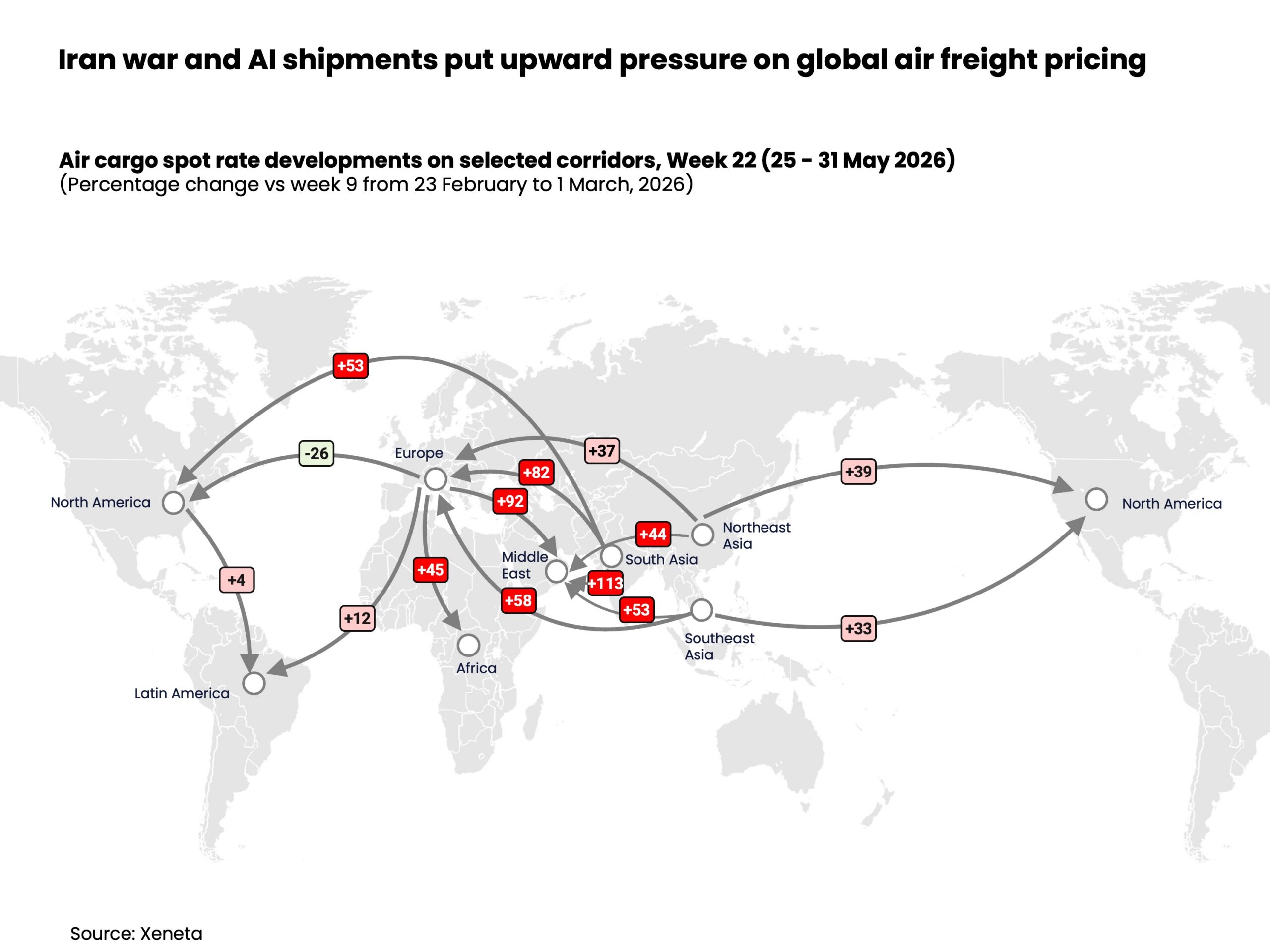
At the corridor level, the drivers of elevated rates sit in a handful of trade flows rather than across the global market. Artificial intelligence is the clearest of them: shipments tied to data centres and semiconductors continue to push transpacific volumes, making it the strongest corridor so far this year.
Renewed missile activity during the US-Iran ceasefire stalled some capacity recovery into and around the Middle East in May, keeping rates on Europe, South Asia and Southeast Asia corridors to the region elevated, even as they have come off their April peak. Spot rates rose by double and triple digits versus late February, the largest reaching +113% in the week ending 31 May.
The Europe to North America corridor once again stood out last month. Although demand on the transatlantic firmed in May, ample capacity from summer passenger schedules is putting downward pressure on rates compared to a year earlier, Xeneta said.
Looking ahead, for shippers who have postponed tenders and bought time with short-term extensions and surcharges, the combination of an anticipated slack summer and long-term rates already past their peak is a more useful and welcome signal.
A bumpy time ahead for e-commerce volumes?
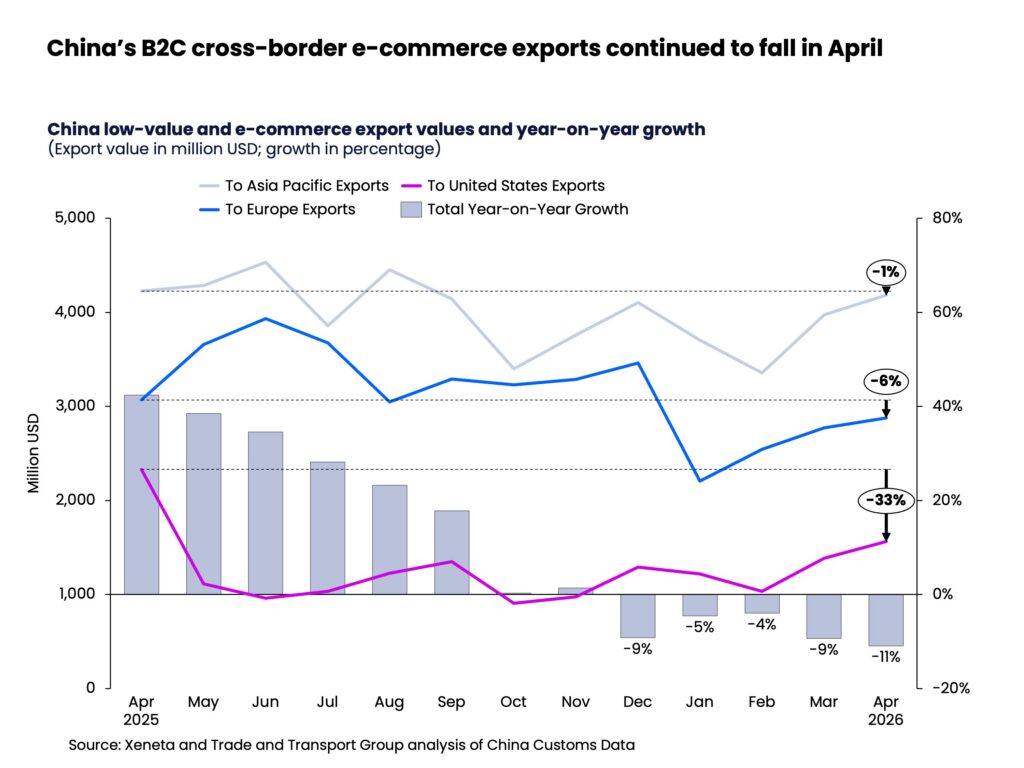
China’s low-value and e-commerce exports fell -11% year-on-year in April, their fifth consecutive monthly decline. The pull-back is uneven by destination: shipments to the United States collapsed -33%, while volumes to Europe (-6%) and Asia Pacific (-1%) held up far better.
For air freight, the B2C e-commerce growth engine has stalled – though part of the apparent decline reflects a shift out of individual B2C parcels into bulk, consolidated air freight shipments that fall outside the e-commerce parcel data, rather than volumes simply disappearing.
More regulatory tightening, however, will not improve the market mood for a recovery of e-commerce volumes. From 1 July, the EU scraps its €150 de-minimis exemption, replacing it with a flat €3 duty per item from outside the bloc, with a further €2 handling fee expected around November – aimed squarely at the fast-fashion parcels of Shein, Temu, and AliExpress.
Early national moves hint at the disruption a clumsy rollout of these new charges could cause. When France brought a parcel levy forward, small-parcel volumes through its main hub fell sharply as shipments were simply rerouted to neighbouring countries. Integrators have cautioned that some of the reform’s technical and data requirements may be hard to implement in time, raising the risk of parcels being held at borders.
Xeneta expects the e-commerce sector to adapt rather than rupture, with volumes not expected to fall away massively, but to keep flowing and reshape around the new rules, much as platforms did after the US de-minimis shock by opening new routings within weeks.
Are more tariffs on the way?
Shippers and air freight stakeholders will be closely monitoring the trade tariffs story, which has also reopened. After the US Supreme Court struck down the Administration’s ‘emergency’ IEEPA tariffs in February, the White House has found a new legal route for implementation.
In early June, the US Trade Representative proposed an additional tariff of +10–12.5% on goods from 60 trading partners, including the EU and China, on the grounds that they have failed to introduce or properly enforce bans on forced-labour goods. Brought under a Trade Act Section 301 investigation rather than emergency powers, the measure remains a proposal ahead of hearings in early July, and the EU has called the proposal unjustified.
The outlook? “Don’t expect a hot summer for air freight demand,” says Niall van de Wouw.