


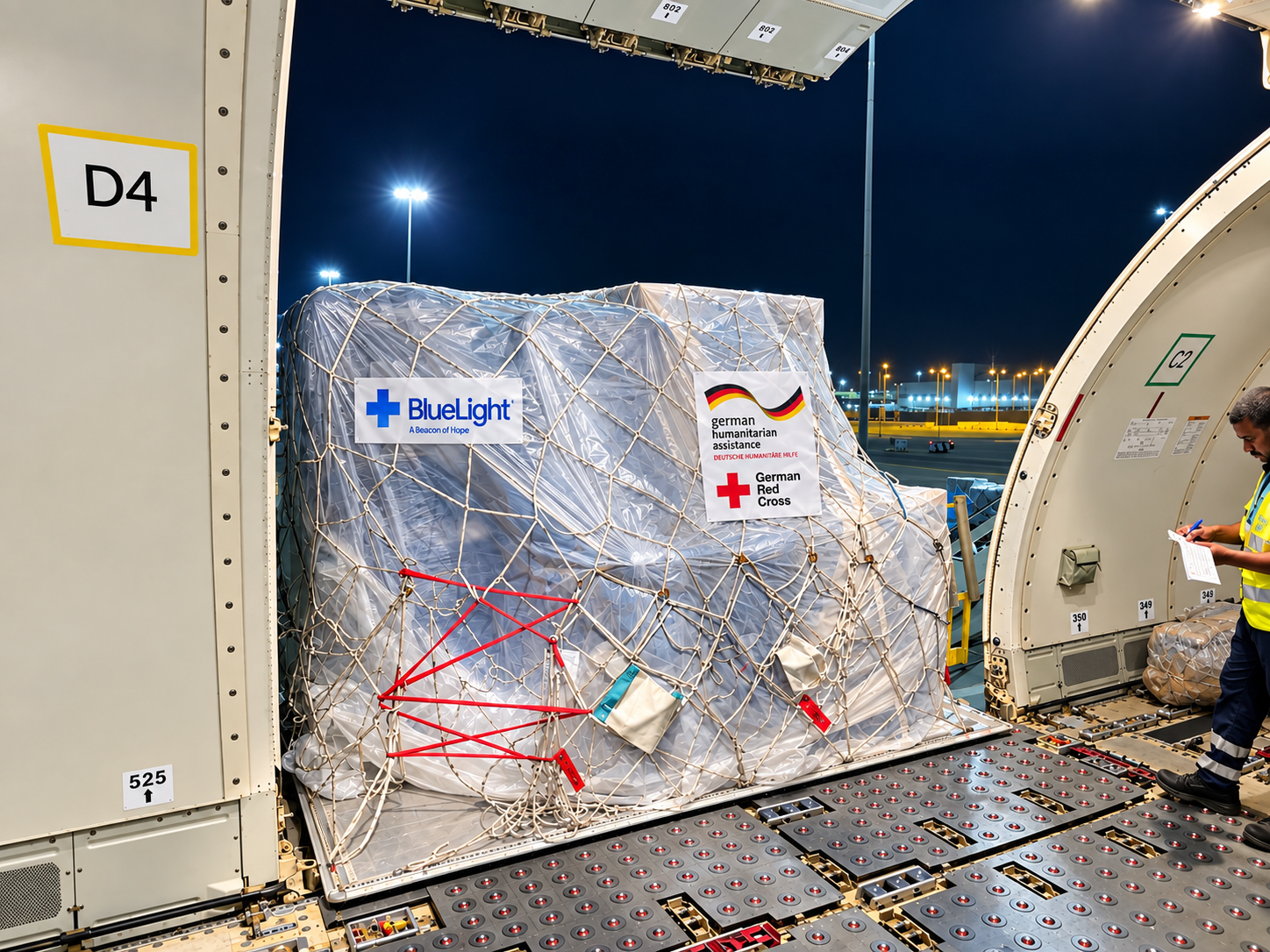
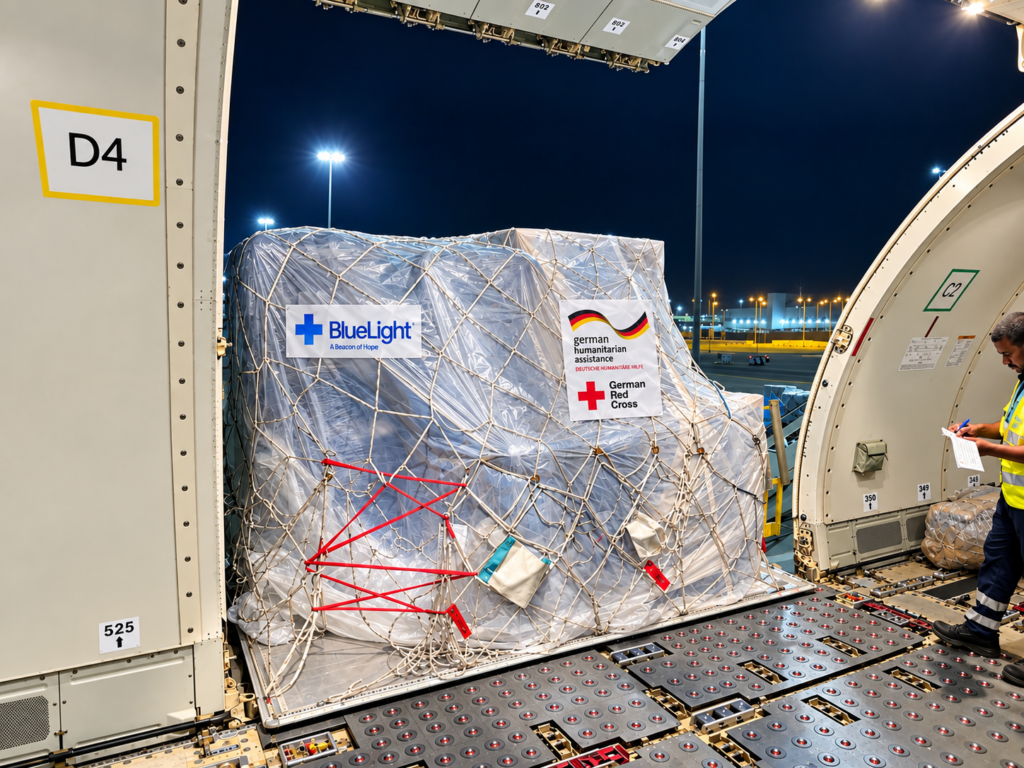
BlueLight Humanitarian Airlines (BlueLight) has completed its first humanitarian mission, delivering 49 metric tons of emergency relief across 125 pallets from Dubai World Central to Kathmandu on behalf of the Belgian Red Cross-Flanders, after severe flooding in Nepal. The relief supplies were procured and donated by the Belgian Red Cross and the IFRC. BlueLight’s role was to move them.
The chartered Boeing 767 freighter left Dubai World Central on 20 September carrying 125 pallets of relief donated by the Belgian Red Cross and the IFRC: kitchen sets, high and medium thermal blankets, jerrycans, geodesic family tents and Xpert 48 tents, all bound for communities affected by the floods.

On 26 August, flash floods struck Rasuwa, Nuwakot and Dhading. Rasuwa was cut off by road and, according to the Belgian Red Cross, around 17,000 people needed assistance. The Belgian Red Cross had relief supplies ready in Dubai and needed to move them to Nepal quickly.
BlueLight does not yet operate its own aircraft; however, within 30 hours of receiving the cargo requirements, it had identified a suitable Boeing 767 freighter and submitted a formal proposal to the Belgian Red Cross.
The cost of the charter was subsidised by BlueLight so that the rate paid by the Belgian Red Cross was below prevailing market rates for comparable aircraft. This was only possible because of the way BlueLight is built. Commercial activity, and the support of its donors, allow the organisation to offer humanitarian rates to the Red Cross, Red Crescent and other NGO partners, so that more of a relief budget reaches the people it was raised for.
Although the aircraft was quickly secured, around 14 days passed between the first request and take off. During this time, cargo planning, documentation, regulatory approvals, airport handling and slot allocation, all of which had to happen in sequence rather than in parallel, were finalised. It reflects the challenges faced by humanitarian organisations whenever air capacity has to be assembled after an emergency has already started, and it is not a reflection on any organisation involved.
Kathmandu added further demands. Tribhuvan International Airport sits in mountainous terrain, with approach requirements and aircraft performance limits that narrow the pool of suitable operators and constrain how much an aircraft can carry. The mission called for aviation, regulatory and humanitarian processes to be aligned across several countries at once.
Waleed Rawat, Co-founder and CEO of BlueLight Humanitarian Airlines, said: “Our first mission showed what determined collaboration can achieve, and why dedicated humanitarian aviation is needed. We do not operate our own aircraft yet, and within 30 hours we had secured a freighter for the Belgian Red Cross and subsidised the rate so that more of their budget could reach families in Nepal. From that moment, everyone involved worked with complete focus to move the relief as quickly and as responsibly as possible.
“Even so, around 14 days passed between the request and takeoff. Those 14 days are not a criticism of anyone. They are what happens when humanitarian air capacity has to be built from nothing after an emergency has already begun. BlueLight was created to change that. We want the aviation part of a humanitarian response to be ready before the call comes, with the discipline of commercial aviation and the urgency and transparency that humanitarian work demands.”
“We are grateful to everyone in Flanders whose donations helped make this relief flight to Nepal possible. By working closely with our partners, we can deliver aid efficiently to families affected by the floods. This mission shows how their generosity translates into practical help where it is needed,” said Jan Poté, spokesperson for Belgian Red Cross-Flanders.
Pierre Bernheim, Co-founder of BlueLight Humanitarian Airlines, said: “Humanitarian aviation takes far more than an available aircraft. It takes crews, airports, regulators, ground handling, documentation and performance planning, all aligned, and often in some of the most demanding places in the world. Our aim is to have those capabilities in place in advance, so that when humanitarian organisations need to move, the aviation side is ready and waiting.”
From improvised capacity to readiness
BlueLight is building a humanitarian aviation model designed to remove the delay, uncertainty and price volatility that come with finding aircraft on the open charter market during an emergency. With its own fleet, aircraft availability would be known in advance, humanitarian procedures would be agreed before deployment, and much of the commercial and operational groundwork would already be done. Steps that currently follow one another could run alongside each other, cutting mobilisation time while keeping every safeguard in place.
Those safeguards matter. Documentation, customs clearance, government authorisations and humanitarian tracking exist to make sure relief reaches the people it is meant for. BlueLight’s aim is not to work around them, but to build a model where aircraft readiness, approvals and logistics can progress at the same time.
Mission 01 is BlueLight’s first operational deployment. In the longer term, the organisation intends to give NGOs, Red Cross and Red Crescent societies, international agencies and other humanitarian actors access to dedicated aircraft at fair and predictable rates, funded so that humanitarian pricing does not depend on the charter market.
“What matters about this mission is not only what moved from Dubai to Kathmandu, but what it taught us,” Rawat added. “The relief arrived because organisations worked together with urgency, discipline and trust. Our job now is to make sure that next time, the aviation part of the response is already in place.”