


In the little over 15 years since its opening, Munich Airport (MUC) has transformed itself from a small regional airport to Europe’s 7th largest, not tomention, its fastest growing large airport.

Over that time period MUC saw its passenger traffic more than double and its cargo traffic more than triple.
This necessitated a second terminal in 2003 and now a third runway which the airport’s CEO Michael Kerkloh said is currently in the approval process and expected to be operational by end-2011. The 4,000 metre runway will also be operated independently from the existing two runways which enables higher capacity.
In 2006 this growth saw some 30.8 million passengers, up 7.5 per cent year-on- year; 400,000 aircraft movements, up 3 per cent; and 400,000 tonnes of cargo throughput (of which 224,000 was fl own), up 11 per cent, at MUC.
Highlighting these growth figures – which are all above European averages – Kerkloh said he expects to achieve at least these volumes for 2007, pointing to the first nine months of the year which saw 184,000 tonnes of air cargo handled, an increase of nearly 13 per cent over the same period 2006.
By 2020 the passenger figure is forecast to rise to 57 million passengers and 607,000 aircraft movements, while cargo volumes will rise to 945,000 tonnes by 2015.
Munich is outpacing its counterparts throughout Europe for a number of reasons, not least because of space. “We still have room to grow,” says Kerkloh, a claim that not many European airports can stake serious claim to.
“Cargo is not only good, but very good,” said Kerkloh of the airport which has become a major passenger hub airport with significant cargo handling interests. “It is good not only in terms of volume this year, but also in terms of traffic growth in general.”
In fact, MUC handles nearly 82 per cent of the total throughput of Frankfurt Airport which has three runways in operation.
“At the moment we are one of the fastest growing large airports in Europe and this also applies to cargo. While we are not a cargo-only airport, cargo of course becomes more and more important,” he said.
In fact, cargo has become so important that it has been defined as a strategic growth area for MUC, alongside its more traditional long-haul passenger service development.

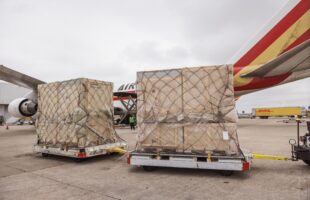
The main factor driving cargo growth at MUC continues to be the increasing number of intercontinental flights – as more than 70 per cent of the airport’s air cargo throughput is carried on long-haul routes as belly cargo – particularly those operated on Asian and US routes.

India, the Middle East and Eastern Europe are also emerging as key growth markets.
Major contributors to the cargo performance include existing long-haul passenger services operated into Munich, including Air Canada, Air China, Delta, Emirates, Etihad, Lufthansa, Qatar Airways, Saudi Arabian Airlines, South African Airways, Thai Airways, United Airlines and US Airways.
The airport’s network currently includes 90 airlines, flying to 182 destinations in 67 countries, of which 42 are long-haul. “We are also home to the strongest alliance in the world – the Star Alliance – and as the alliance grows stronger, so do we.”
Kerkloh also expects Africa to come into focus: “South Africa is a key market but in the medium term I think when Africa gets its economy on track we will see an increase in African services very soon, within 3-5 years.”
“Already there are some signs that those areas which have a more stable political environment will see traffic develop very, very quickly,” he added.
Currently MUC has three flights a week between Munich and Johannesburg with South African Airlines, which will increase to daily from this coming July as the carrier adds capacity.

Lufthansa, which jointly developed Terminal Two with the MUC’s operating company FMG (Flughafen Munchen GmbH), is also aggressively expanding its services, according to Kerkloh, and will see a direct connection to Singapore next year along with additional China services from both Lufthansa and China Air.
Strong impetus also continues to come from the express services operating in Munich. DHL, Fedex, UPS and TNT achieved signifi cant increases as compared with the same period a yearearlier.
But while the majority of fl own airfreight at the Bavarian hub is still carried as belly cargo on passenger flights, Kerkloh said MUC is catching the eye of dedicated cargo carriers.
“We do feel that we have become more and more attractive for cargo-only services and we can see that in the developments this past year.”
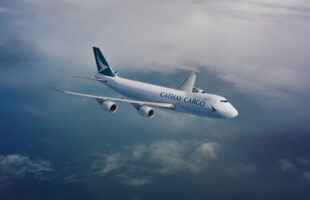
He points to BA World Cargo, Cathay Pacific, CargoItalia, Korean Air Cargo, Emirates Skycargo and Polet which now all have regular cargo-only services into Munich. He expects this all-cargo growth to continue throughout this year with Emirates, for instance, planning to add capacity between the Middle East and Munich.
Another key advantage that MUC enjoys is its strategic location, smack in the middle of the new European Union following the addition of 12 eastern European countries which, “boosted Munich Airport from a fringe role to the centre of the EU”.
This has helped attract new cargo-only customers, Kerkloh said, “because they see that some markets out of here are underserved or suffer from non-optimal situations like Italy, for instance, where Alitalia faces an uncertain future.”
“Some of the cargo streams in Europe are not optimal,” he said pointing to the fact a lot of cargo coming from southern Germany, Southeast Europe (Croatia and the former Yugoslavian republics), Italy and Austria is trucked to Frankfurt.
“The long distance trucking is not necessary anymore because we now have an attractive network for the companies doing forwarding or exporting.”
“This will be one of our main arguments when we try to interest intercontinental carriers because they can see transport times into regional destinations become shorter. You could say this is our local catchment area.”
Making this work involves engagement in getting ground facilities in place and getting a conviction by forwarders and other freight people to consider Munich as an alternative to other large airport hubs, Kerkloh said.
This was a key impetus behind MUC’s new facility for freight forwarders which opened recently. The first phase of the development that has now been completed provides total floor space of 15,000 square meters for the use of freight forwarding companies of which four will initially set up operations in the facility. Expansion is possible in the form of a second phase with a total additional area of up to 15,000 square meters.

“The era when cargo traffic was seen as an afterthought to passenger operations at Munich Airport can now be considered a thing of the past,” said Walter Vill, the CFO and deputy CEO of FMG at the opening of the new facility.
“Over the years, a European-level logistics center has taken shape here that can confidently face any comparison at the national or international level,” he added.
And MUC is set to become a major perishables distribution centre for Thai food and agricultural products into Europe following a recent agreement signed between Munich Airport International, its cargo handling subsidiary, Cargogate and Thai Airways International along with the Thai Airfreight Forwarders Association.

This will make MUC the gateway for Thai products into Munich’s catchment area and beyond into the rest of Europe. Currently Thai operates daily A340-600flights into Munich.
The perishables centre is also drawing interest from other carriers that had previously not considered Munich as an alternative to other hubs, including Gulfbased carriers, Kerkloh added.
Going forward Kerkloh is confident of the long-term value proposition that MUC can off er. He’s also not concerned by up and coming Eastern Europe airports that are hungry for a slice of the cargo business.
“You have to differentiate between the large hubs that are also cargo hubs – like Munich – and those airports that are more and more specialised on cargo-only operations, like Leipzig/Halle.
“Leipzig/Halle will grow very, very quickly and will become very important as far as cargo-only services are concerned,” he said.
“But our growth will be more along the long-haul development of passenger aircraft and will focus on the large markets in the respective emerging economies.”
Kerkloh is confident of similar cargo growth for next year, saying: “We know from the market they have indicated that they need more space at the airport. We have to allocate that space and we have to find new space and that’s what we’re looking at now.”