

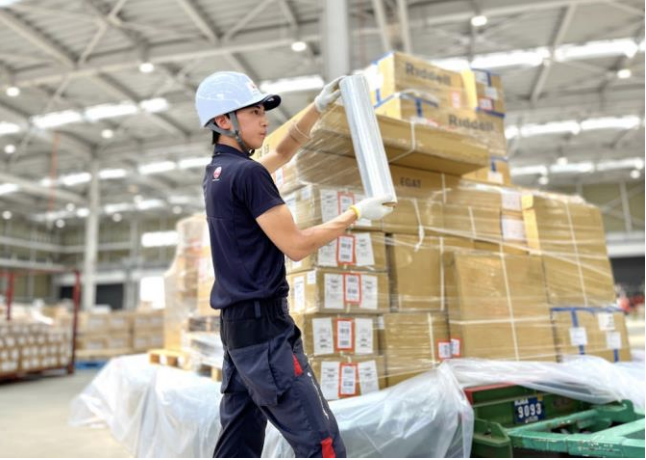
Starting in October 2025, JAL will sequentially introduce cargo stretch films made from biomass materials using the mass balance method at domestic airports. This marks the first initiative within Japan’s aviation industry.
Compared to conventional methods, the mass balance method reduces concerns about raw material shortages and requires no large-scale capital investment. Additionally, this method achieves physical properties equivalent to those of conventional petroleum-based products. JAL expects to reduce CO₂ emissions by approximately 50 tons annually with the use of these films.
According to the JAL Group Medium-Term Management Plan (Rolling Plan 2025), efforts are underway to reduce single-use plastics derived from fossil fuels. The cargo division actively promotes the use of materials containing eco-friendly components, aiming for efficient use of limited resources and reduced environmental impact. With the introduction of these new stretch films, 100% incorporation of eco-friendly materials in cargo handling supplies will be achieved as planned.
About the mass balance method and the new stretch film
The mass balance approach is a method used during product processing and manufacturing where multiple raw materials are blended, and the characteristics of each material are properly allocated to the final product according to their blended proportions. This approach allows assigning biomass materials to produce stretch films with quality equivalent to those made from 100% petroleum-based raw materials. Furthermore, the biomass materials incorporated in the stretch films are derived from biomass naphtha—a byproduct obtained during the production of Sustainable Aviation Fuel (SAF)—thereby maximising the effective use of limited resources.
The new stretch film incorporates polyethene with 100% biomass content assigned through the mass balance method, blended at approximately 25% biomass-based plastic. At Narita Airport, JAL Cargo Service and JAL Cargo Handling have verified that handling quality equivalent to the conventional standard can be ensured, and have decided to proceed with the implementation.
Cooperating partners
Mitsui Chemicals, Inc., Prime Polymer Co., Ltd., TANIX CO.,LTD., Tsukasa Chemical Industry Co., Ltd.
The JAL Group continues to advance initiatives for the effective use of limited resources and reduction of environmental impact, while maintaining the delivery of high-quality cargo and mail handling services.