
The resilience of the global air freight market is being tested once again as conflict in the Middle East places a further question mark against already low growth expectations for 2026, but lessons from past crises are bringing some short-term stability as shippers, airlines, and forwarders wait to see what unfolds in the region, and its long-term impact on the global economy, says industry analysts, Xeneta.
Historically, air freight has served as an equaliser during supply chain crises, notably Covid and the Red Sea disruption. When ocean freight shipping faltered, air cargo stepped in to fill the gap. This time is different. Unlike previous shocks, the current conflict is hitting airlines and the air cargo industry harder than ocean shipping, amidst fears the worst may be yet to come.

“Typically, at the start of each month, we report the global air cargo market’s performance for the previous 4-5 weeks – but, right now, whether demand was down -2% or -4% in March does not concern the industry greatly if we are on the verge of a global economic crisis,” says Niall van de Wouw, Xeneta’s Chief Airfreight Officer.
“There is clearly a lot of concern and unanswered questions about the market outlook, but we also see a current transparency and maturity in customer and supplier relationships, and a sense of solidarity that, although the impact of the conflict is beyond their control, they will get through it together.”
Cost is only one variable
Van de Wouw added: “Air freight rates are going up, and we already see evidence of the Middle East conflict reshaping global air freight pricing, but, for shippers, cost is only one of the variables. Protecting market share and service to customers also plays an important role.
“Will the increase in fuel prices dampen demand for air freight? Not immediately, but if this conflict continues in the longer term, then definitely yes because the world would be facing a much broader economic issue.”
Until then, he expects the air freight industry will continue to find a way to transport goods, ‘but that will come at a cost’. He highlighted how capacity has shifted to safer airport locations such as Muscat and Jeddah to keep air cargo supply chains moving and expects to see more such flexibility.
“Right now, we can see a lot of solidarity and trust between shippers, forwarders, and airlines to get goods moved. We see businesses respecting contracts as much as they can and sticking to what they have agreed as they wait to see what unfolds,” he said.
Hopes pinned on a fast resolution
Air cargo stakeholders are pinning their hopes on a fast resolution to the current situation in the Middle East.
Cities like Dubai and Doha occupy strategic midpoints between the Americas, Asia, and Europe, and have served as the growth engine behind the rise of super-connectors like Emirates, Etihad, and Qatar Airways. Now, geographic advantage has become a strategic vulnerability as hub airports have become victims of the conflict.
The ripple effects reach even further. An oil shock has nearly doubled jet fuel prices, squeezing carriers that are already rerouting or grounding flights due to financial pressures.
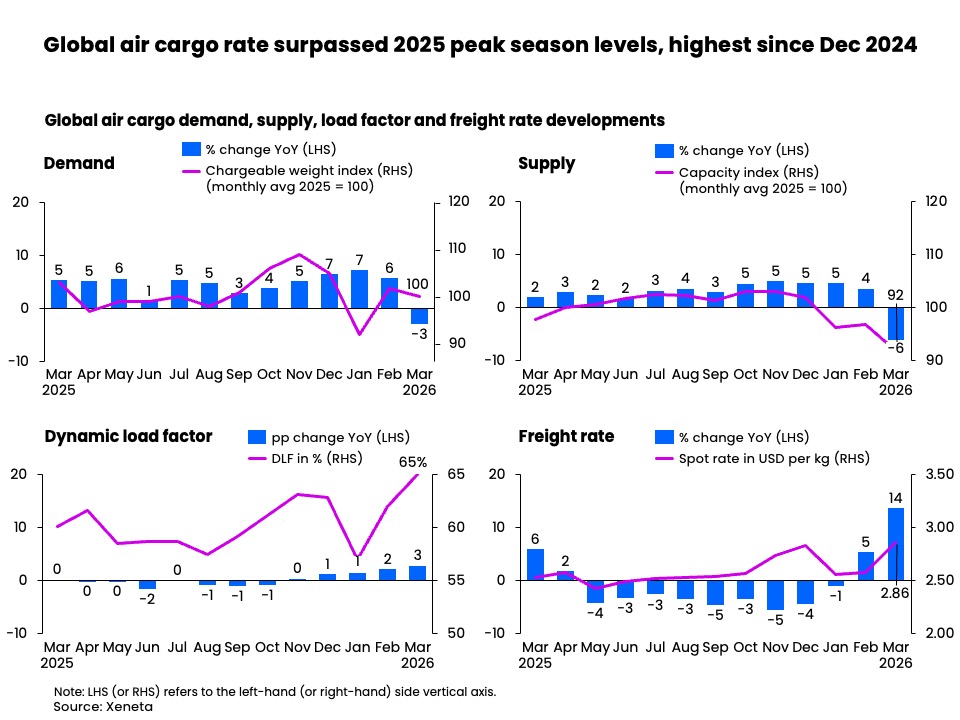
Five weeks into the conflict, air cargo capacity in the region remains roughly -30% below pre-conflict levels – and that squeeze in supply is showing up in rates. Global air cargo spot rates in March surpassed 2025 peak-season levels, reaching USD 2.86 per kilo – their highest point since December 2024.
Timing is particularly damaging
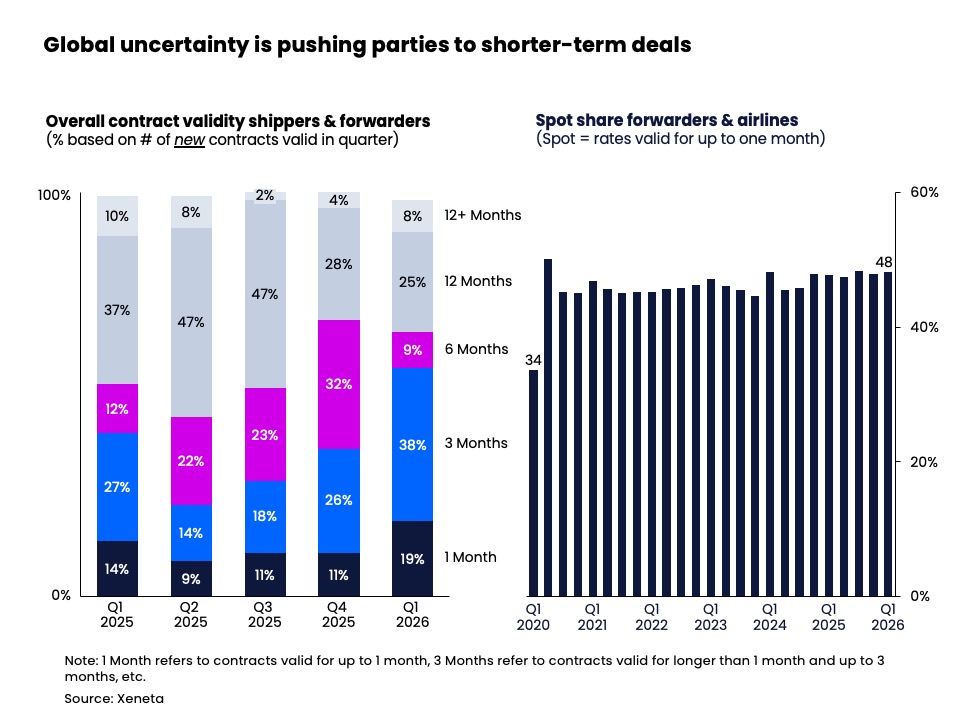
The conflict escalated in the middle of tender season for annual airfreight contracts, accelerating a shift already underway: in Q1 2026, shippers moved meaningfully towards three-month agreements over annual contracts, compressing rate validity across the market. This is in line with Xeneta’s advice. “We have been recommending postponing tenders during the present uncertainty, because what is the value of making a longer-term commitment now when the whole backdrop can change so quickly?” van de Wouw said.
For airline-forwarder negotiations, Q1 2026 echoes the dynamics that emerged during Covid. In March, the share of global volumes shipped under spot rates rose three percentage points to 52% – just one point below the level recorded at the onset of the pandemic.
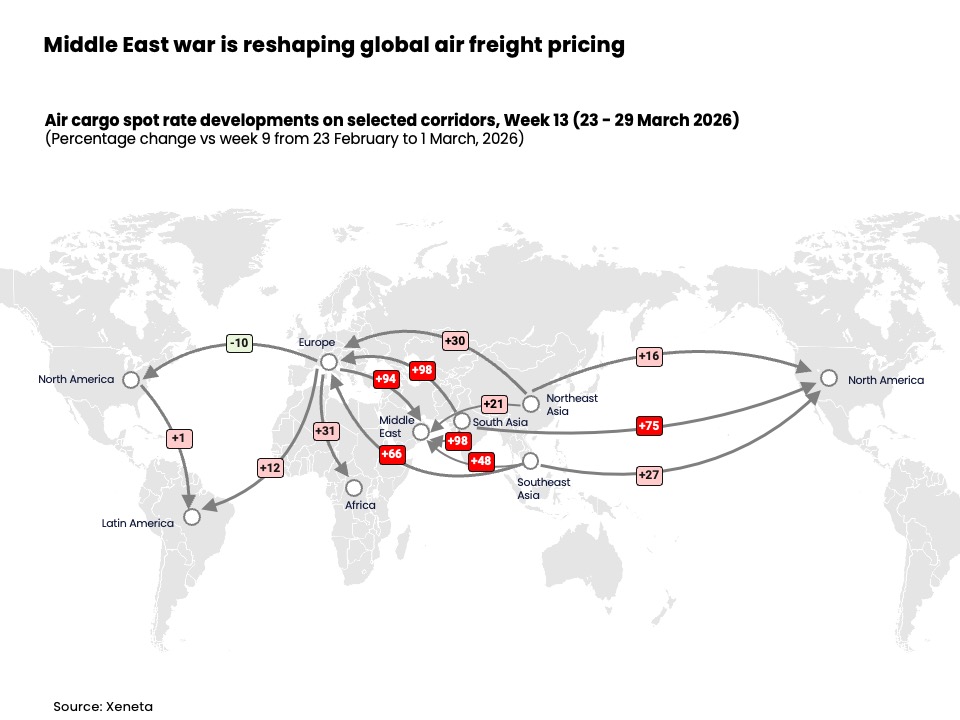
The rate impact has been sharpest on outbound corridors from South Asia and Southeast Asia to the Middle East. Spot rates surged +50–100% in the week ending 29 March, compared to just four weeks prior. The spike reflects a convergence of pressures: severe capacity shortages from heavy reliance on Middle Eastern carriers, near-doubled jet fuel costs, and newly added war-risk surcharges.
The disruption is no longer contained to the Middle East. Because the region accounts for roughly half of all capacity on Asia–Europe corridors – and for South Asia onward to the Americas – the squeeze is now reshaping flows across entire lanes.
Spot rates from Southeast Asia and South Asia to Europe have followed similar trajectories, given Middle Eastern carriers’ dominance on those routes. By contrast, Northeast Asia–Europe lanes have held up comparatively better as airlines deployed more direct flights to compensate. Europe–Africa corridors registered +31% rate growth, reflecting the Middle East’s role as the primary transit hub connecting the two regions.
Rates up by mid-high double digits
Five weeks in, the pressure has spread well beyond the immediate Asia–EMEA region. Rising jet fuel costs have pushed air freight rates from Northeast Asia and Southeast Asia to North America up by mid-high double digits. South Asia–North America rates surged even higher, up approximately +75%, again driven by Middle Eastern carriers’ significant share of that corridor.
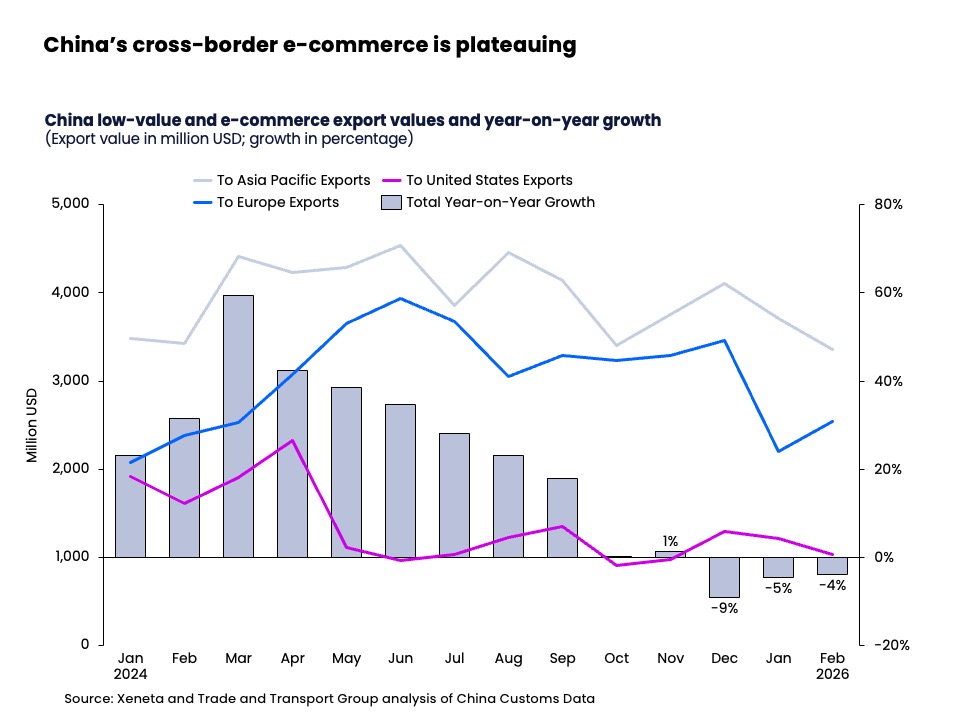
But longer-term rates tell a different story. Rates valid for more than a month on Northeast Asia and Southeast Asia–North America lanes rose by only low single digits compared to four weeks earlier, as US tariffs and the unwinding of de minimis exemptions continue to weigh on demand across those corridors.
Not all lanes are moving in the same direction. Europe–North America spot rates fell by some -10% in the week ending 29 March compared to four weeks prior, as summer passenger schedules restored belly cargo capacity to the market. North America–Latin America rates held broadly flat over the same period, while Europe–Latin America spot rates rose approximately +12%, reflecting capacity withdrawals from that corridor.
Airfreight demand might receive a temporary boost from ocean carriers declaring ‘end of voyage’ at ports outside of their intended destination, leaving shippers and forwarders to recover their supply chains, van de Wouw said, but any gains might be short-lived.
Fallout is bigger than tariffs
“Tariffs created uncertainty, but the fallout here is bigger because of the cost of jet fuel, the potential energy crisis. and inflation growth. Right now, the air cargo market is suffering from a supply issue – and this will be resolved. But the longer this recovery takes is going to determine if it becomes a much bigger demand issue.
“Whether airfreight benefits or suffers in the longer-term is down to the length of the conflict and its outcomes,” van de Wouw said.
For the record, global air cargo demand fell -3% year-on-year in March, while capacity supply was -6% lower than in March 2025. Dynamic load factor – Xeneta’s measurement of capacity utilisation based on volume and weight of cargo flown alongside available capacity – rose to 65%.