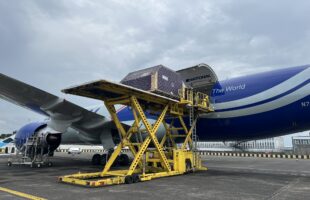

When Skyworks Solutions was named Shipper of Choice – Collaboration at the 12th Payload Asia Awards, the recognition reflected more than strong ties across the air cargo value chain. It underscored how a global technology manufacturer has deliberately engineered its air freight strategy around reliability, transparency, and long-term partnerships—principles increasingly reshaping shipper expectations amid ongoing volatility.

For Barakathulla Buhari, Country Manager and Senior Director of Global Logistics & Fulfilment at Skyworks, collaboration is not an aspiration but a structural requirement—one that governs how the company plans, selects, and manages its global cargo networks.
“At Skyworks, collaboration is not a slogan, but it is the operating model that underpins every link of our global logistics supply chain,” he says, pointing to a system built on transparency, data, and fast decision-making across partners.

Evaluating cargo networks beyond price
Operating in the wireless semiconductor industry means logistics must keep pace with short production cycles, aggressive customer timelines, and geographically dispersed manufacturing across the US, Singapore, Taiwan, Malaysia, China, Japan, and India. As a result, evaluating airline cargo networks is a disciplined, data-driven exercise.
Reliability sits at the top of Skyworks’ criteria. As Barakathulla puts it, “Semiconductor supply chains require deep global coverage and access to remote or capacity-constrained locations.” But uplift alone is not enough. Skyworks looks for carriers that can protect capacity during peak periods, support short-notice surges, and maintain service consistency when markets tighten.
As industry complexity has increased, so too has Skyworks’ evaluation framework—shifting beyond operational fundamentals toward a broader assessment of network resilience, digital maturity, transparency, and strategic alignment.
Securing uplift when it matters most
In an environment where a single missed shipment can disrupt downstream production, Skyworks takes an unequivocal view on the cost-versus-service debate. Customer continuity, Barakathulla stresses, is non-negotiable.
“Cost matters, but service assurance matters more,” he says. “When the market enters a capacity crunch, Skyworks will secure uplift first.”
That philosophy is reflected in how the company designs its networks. Diversified routing strategies—with primary and secondary carriers on each lane—are supported by strict performance metrics, including 99.9% on-time delivery targets, quarterly scorecards, claims history, and operational support quality.
The principle guiding these decisions is simple: “Cost is a variable; customer continuity is not.”
Long-term partnerships as a strategic anchor
While the spot market plays a role, Skyworks’ air cargo strategy is anchored in long-term partnerships designed to deliver predictability and resilience.
“Long-term strategic partnerships form the backbone of Skyworks’ air cargo strategy, while spot-market arrangements play a targeted, complementary role,” Barakathulla explains.
Annual AI-driven request-for-quotation (RFQ) processes establish baseline reliability and structured lane awards, while spot RFQs provide agility during unexpected surges or last-minute routing constraints. Continuous benchmarking ensures competitiveness across both models—without compromising service integrity.
Together, these mechanisms create what Skyworks describes as a high-resilience cargo network engineered for speed, precision, and customer commitment.
Managing risk through real-time visibility
Operationally, Skyworks relies on a real-time control-tower model to anticipate disruptions and intervene early. Centralised, AI-driven tracking platforms—integrated via electronic data interchange (EDI) and API with multiple forwarders—give teams continuous visibility across global lanes.
Daily performance reports, milestone tracking, and exception alerts enable corrective action before delays impact customer commitments. According to Barakathulla, this level of coordination is essential to maintaining above 99% on-time delivery performance across a predominantly air-freight supply chain.
Turning complexity into trust
As a wireless semiconductor manufacturer with a logistics network that is approximately 95% air-freight dependent, complexity is a given. Skyworks’ response is to standardise visibility and decision-making across partners.
By consolidating EDI and API feeds into a single performance cockpit, both internal teams and external partners work from the same data—covering milestones, dwell times, and ETA confidence at the lane level. Explicit targets, weekly operational huddles, and quarterly business reviews remove ambiguity and accelerate response times when capacity tightens.
“This triad—visibility, communication, responsiveness—is how we and our cargo partners convert complexity into reliability,” Barakathulla says, “and reliability into long-term trust.”
Designing networks for volatility
Network planning at Skyworks blends global governance with regional optimisation. Detailed operational mapping defines cut-off times, buffer assumptions, capacity commitments, and recovery workflows across markets.
This structure allows the network to remain stable even under volatile demand, geopolitical disruptions, or weather-related constraints. Assured uplift during peak seasons, alternative gateways, and pre-approved premium options are built into planning models to protect customer continuity under all scenarios.
Raising the bar for cargo partnerships
From a shipper’s perspective, Skyworks believes airlines and cargo service providers can further strengthen their value by focusing on uplift certainty and predictive intelligence.
“Semiconductor shippers don’t just need lift—we need certainty, speed, and data-driven collaboration,” Barakathulla notes.
Consistent API and EDI data quality, predictive ETA models, and faster exception notifications are increasingly critical in supporting high-value, time-sensitive supply chains operating with little margin for error.
The AI-driven future of collaboration
Looking ahead, Skyworks sees AI and data analytics reshaping shipper–carrier relationships from transactional coordination to predictive, automated collaboration.
AI-driven tools are expected to anticipate congestion, simulate alternate routings, optimise load planning, and continuously assess carrier performance in real time—reducing manual intervention while increasing network resilience.
“The future of air logistics will belong to partners who embrace digital collaboration,” Barakathulla says. “AI will be the catalyst that lifts the entire industry to that next level.”
This story was first published in the January-February 2026 issue of Payload Asia.