
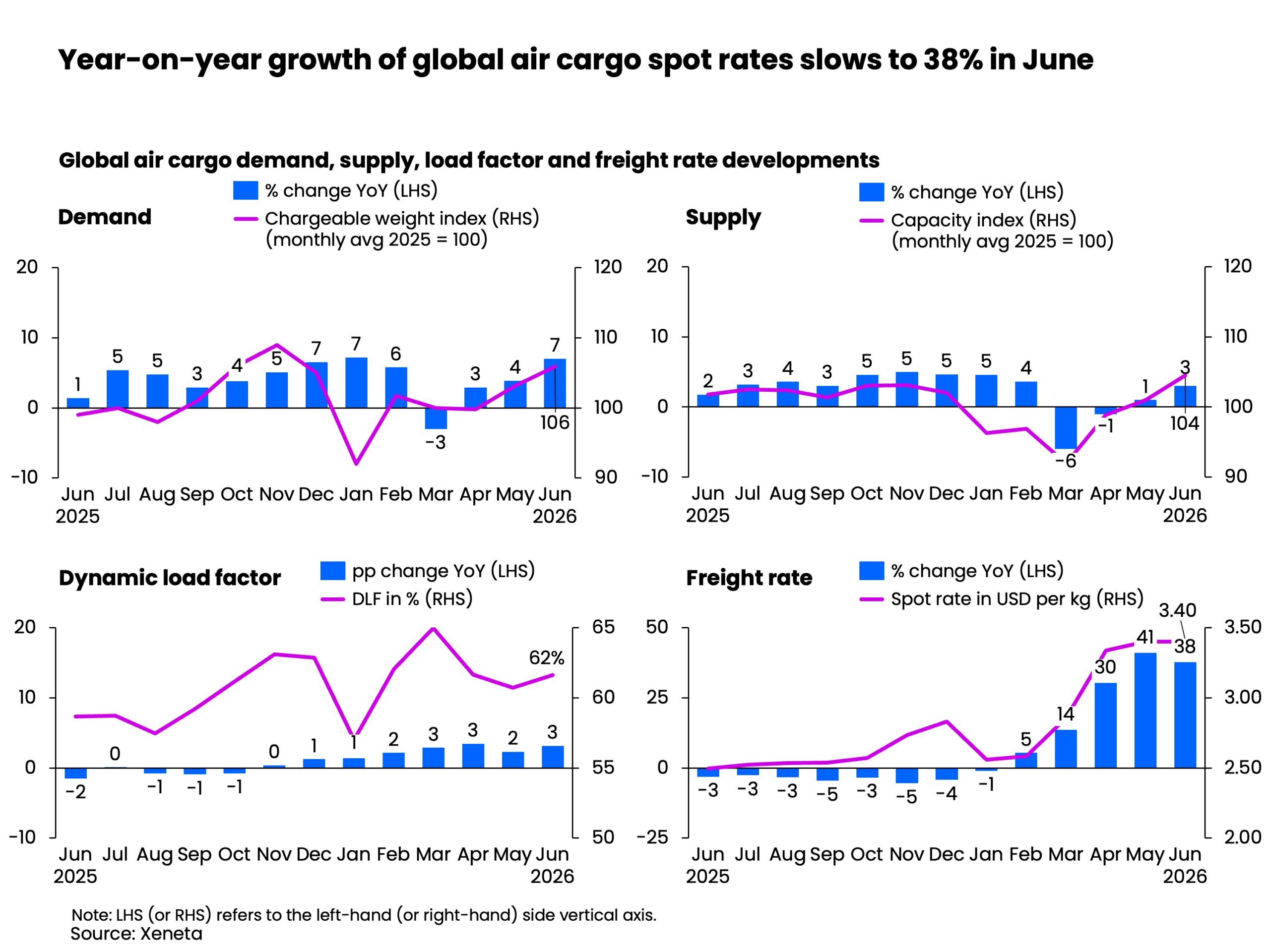
Exceptional demand for semiconductors and AI-related hardware inspired a +7% growth in global air cargo demand in June, but spot rates continue to ease in line with expectations after a calming of the Middle East conflict, restoration of capacity through the big Gulf airport hubs, and a fall back in jet fuel prices, according to the latest market data from industry analysts Xeneta.
Global air cargo spot rates (valid for up to one month) rose +38% year-on-year in June to an average of USD 3.40 per kg, but, as Xeneta predicted, the pace of growth is slowing, easing from +41% in May – a sign the market is calming from a pricing perspective.


The big surprise remains demand as AI volumes continue to make up for the fall in e-commerce traffic, air cargo’s main growth engine over the past 2-3 years.
Xeneta’s Chief Airfreight Officer, Niall van de Wouw, called June’s demand growth ‘remarkable,’ and suggested that current air cargo volumes are ‘defying gravity’, thanks mostly to soaring AI-related shipments on Asia Pacific to North America corridors.
“The scale of AI’s impact is easy to underestimate because it sits inside a small slice of total air cargo volume – below 10% of what flies. But the facts that confirm its role as the main driver of air cargo growth are undeniable,” he said.
“Global semiconductor sales more than doubled year-on-year in April, up +106%, the strongest growth since the World Semiconductor Trade Statistics organisation began keeping records in 1986. That surge has made the transpacific this year’s strongest air freight corridor, even as China–US volumes weakened under tariffs.”
Wider evidence reinforces AI’s impact. Taiwan, which manufactures the overwhelming majority of the world’s advanced chips, recorded real GDP growth of +15% in the first quarter of 2026, its fastest quarterly expansion in almost five decades, driven by semiconductor and AI demand. In South Korea, the two largest chipmakers now account for more than half the entire value of the Seoul stock exchange after both roughly doubled/tripled in value this year.
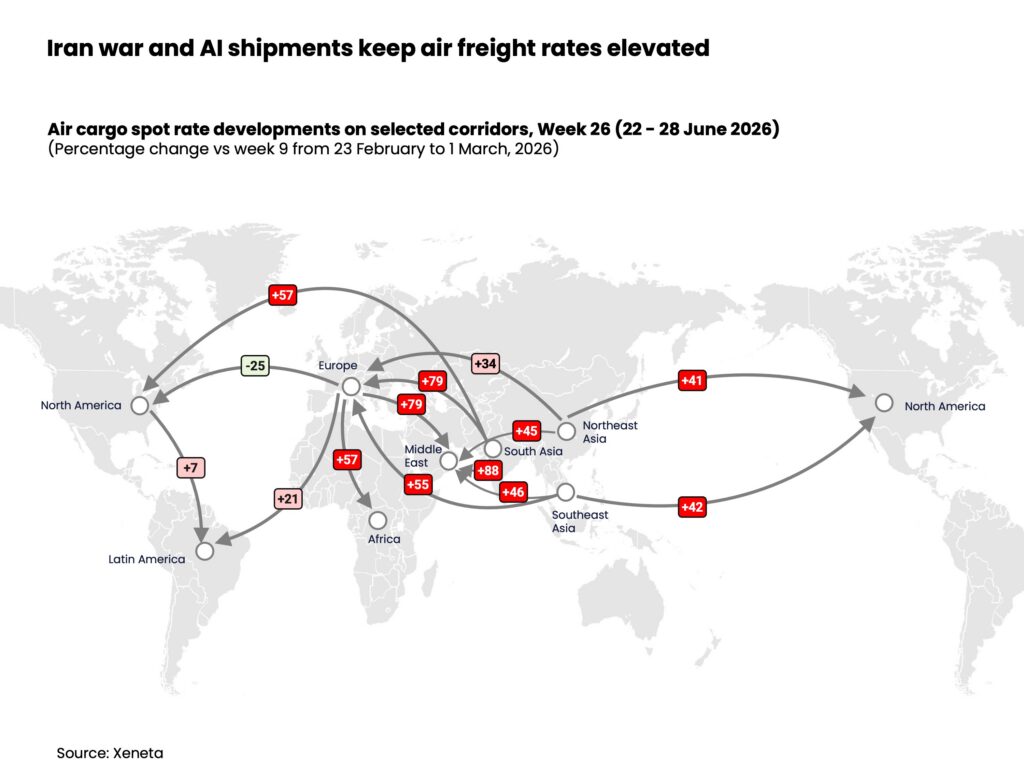
While air freight rates are showing signs of easing globally month-on-month, rates on the Northeast Asia and Southeast Asia to North America corridors gaining most from AI-linked shipments, are a clear expression of the AI success story. These rose +41% and +42% respectively in the final week of June, compared with late February.
Rates remain elevated but are easing
At the corridor level, uncertainty over the lingering Middle East conflict and AI-linked demand into North America are keeping rates elevated – but they are beginning to ease on Middle East corridors. While rates into the region from South Asia (+88%), Southeast Asia (+46%) and Europe (+79%) remain far above pre-conflict levels, Xeneta says the direction of travel is downward month-on-month as capacity returns.
“Of all the predictions we made at the start of the year, the most accurate one was that a wildcard could change everything, and the US-Iran conflict did just that, turning everything upside down.
“What we were thinking at the start of the year was not that global air freight spot rates would be up +38% in June, but now we do see them starting to come down as we expected, albeit at a slower pace than they went up,” van de Wouw stated.
Elsewhere, summer passenger schedules, which flood the transatlantic routes with belly capacity, pushed rates down by -25% from Europe to North America, compared to late-February (winter schedule) levels.
Demand shows no sign of cooling
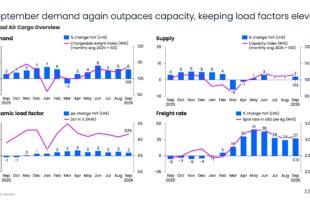
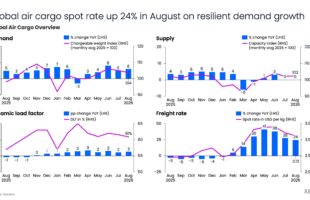
Behind the slowing rate growth sits a demand picture that shows little sign of cooling in the short-term. The +7% growth year-on-year in June was well ahead of expectations and supply, which grew +3%, mostly from the return of capacity suspended by Middle East disruption. The imbalance lifted the dynamic load factor three percentage points year-on-year to 62%. Dynamic load factor is Xeneta’s measurement of capacity utilisation based on the volume and weight of cargo flown alongside available capacity.
Van de Wouw said: “The air freight market has kept on moving and showing its ability to navigate uncertainty. As we have said before, air freight is not in control of its own destiny, but no one can deny its ability to respond and pivot when challenges come along.”
For a market widely expected to have a quiet 2026, the demand strength pushed growth up 4% year-on-year in the first six months of the year, according to Xeneta’s latest Air Freight Outlook Update.
Bust the fuel-float myth, again
The transatlantic corridor also underlines a point Xeneta has made before: air freight pricing follows supply and demand, not fuel costs. Jet fuel prices spiked during the Iran conflict, yet transatlantic rates fell.
“There is not a 1-to-1 correlation that when fuel prices go up, rates must go up. This type of mechanism is prone to unjust adjustments. We have recommended that shippers have a different floating mechanism, which is not dependent on jet fuel costs, but which is based on how much freight forwarders are actually paying to airlines,” van de Wouw said.
E-commerce keeps sliding
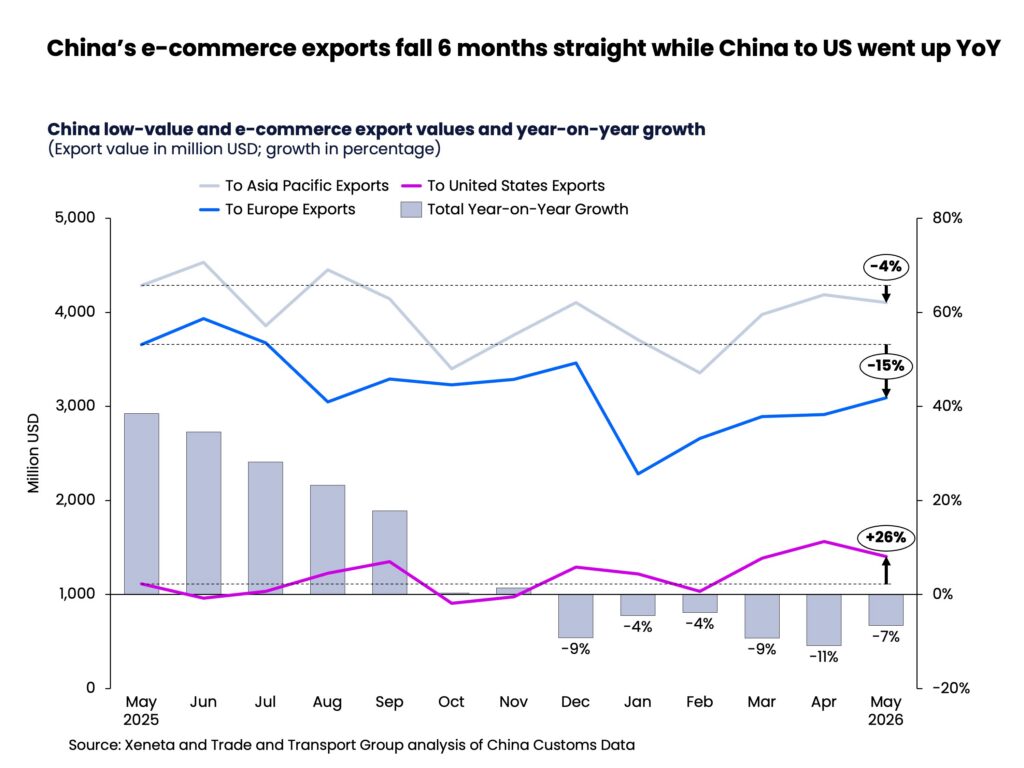
While AI lifts the top line, the e-commerce engine that has powered air freight demand in recent years continues to fade. China’s low-value and e-commerce exports fell -7% year-on-year in May, a sixth consecutive monthly decline, according to the latest China Customs data. The picture is uneven by destination: shipments to Europe fell -15% and those to Asia Pacific -4%, while flows to the United States rebounded +26%, but volumes remain below the levels prior to the de minimis exemption ban.
Part of the apparent decline may reflect a shift rather than a disappearance of volumes as individual B2C parcels are being moved into bulk, consolidated air freight shipments that fall outside the e-commerce parcel data. But the underlying trend is clear. After years as air freight’s single biggest growth pillar, the B2C e-commerce engine has stalled.
The regulatory screw is tightening at the same time. On 1 July, the EU scrapped its €150 de-minimis exemption, replacing it with a flat €3 duty on every item shipped from outside the bloc. A further €2 handling fee is expected around November – a move aimed squarely at the fast-fashion parcels of Shein, Temu and AliExpress. France has gone further still, moving to ban advertising by the same low-cost platforms.
Early national moves hint at the potential disruption a clumsy rollout could cause. When France brought a parcel levy forward, small-parcel volumes fell sharply through its main hub and simply rerouted to neighbouring countries. According to van de Wouw, Xeneta expects the sector to adapt rather than rupture – reshaping around the new rules and opening fresh routings within weeks, much as platforms did after the earlier US de-minimis shock, but ‘the days of e-commerce powering air freight growth are over for now,’ he added.
Freight buyers keep their options open
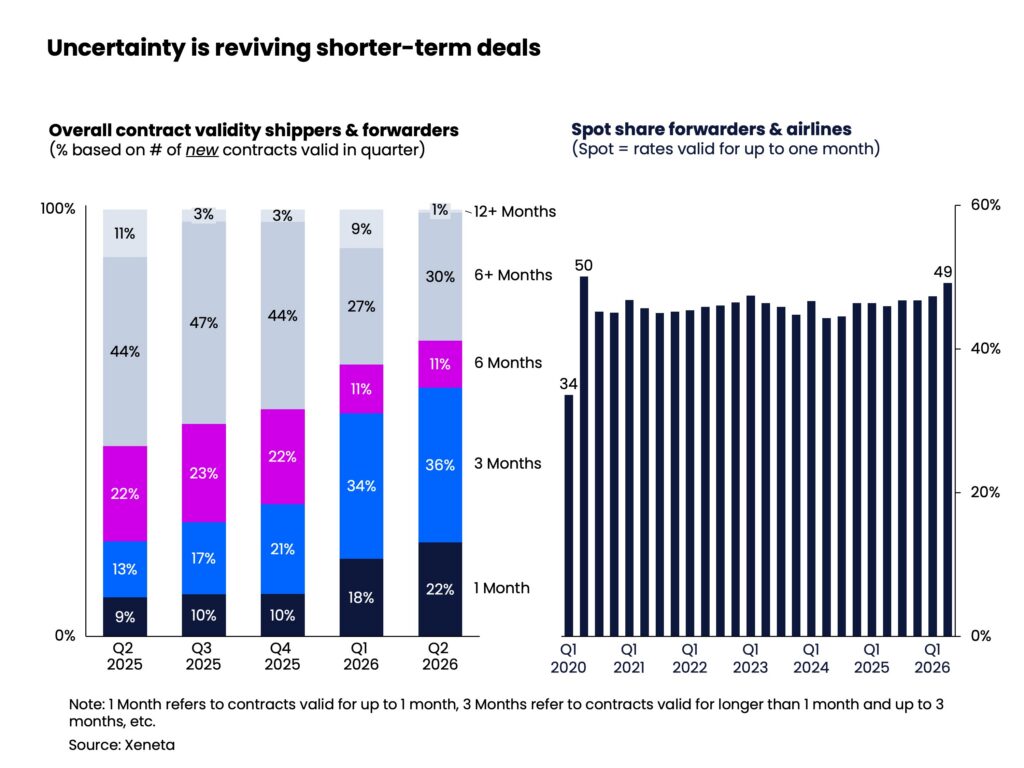
With so little visibility on where the market is heading, shippers continue to favour short-term capacity deals. The share of newly-agreed shipper and forwarder contracts valid for up to three months rose to 58% in the second quarter of 2026, doubling from 22% in the same quarter a year ago.
Similarly, the share of chargeable weight moving on the spot market between forwarders and airlines reached 49% in the second quarter of 2026, up from 34% before the pandemic, nearing their 50% levels during the pandemic high. Roughly half of all volume now moves on short-term rates.
Niall van de Wouw said: “Seeing 50% of total chargeable weight on the short-term market is remarkable and is the clearest indication that nobody really knows where the market is heading, and no one is willing to commit longer-term.
“In the meantime, airlines are riding the wave of higher rates at the cost to shippers and consumers, if these higher prices are passed on. But our advice to shippers when they ask if it’s the right time to go to market is still to hold off and wait to see what unfolds on rates, because the overall trend is downwards.”
How long will the AI boost last?
“AI demand is pushing up the global numbers, and airlines should enjoy it while it lasts,” van de Wouw added.
“Every airfreight growth engine comes to a halt at a certain time, as we have seen with Covid and e-commerce.
“Now we have AI, and no one knows how long it will last. The investment cycle in AI might take a hit, and that could abruptly change the demand we are seeing and add risk, but there are no signs of the AI boost plateauing and pushing air freight demand downwards just yet.”