



• Skip to main content
  • Skip to primary sidebar

Ad – Bottom Content

Payload Asia

How India’s mangoes ride Air India’s long-haul network across the world

Payload Asia

  • Home
  • Latest News
  • Channels 
    • Carriers
    • Aircraft Manufacturers
    • Airports
    • Courier & Mail
    • Freight Forwarders
    • Express
    • Ground Handling & Cargo Terminals
    • Logistics
  • 12th Payload Asia Awards
    • About
    • Categories
    • 11th Payload Asia Awards
    • 10th Payload Asia Awards
    • 9th Payload Asia Awards
    • Awards Gallery
  • Subscribe
  • Advertise
  • More 
    • Event Calendar
    • Directory
    • Contact Us
Share

Leaderboard

How India’s mangoes ride Air India’s long-haul network across the world

June 8, 2026 by PLA Editor


On a humid evening in Mumbai, as Air India’s widebody aircraft prepare for their overnight departures to London, New York and Frankfurt, the cargo holds below the passenger cabins are filled with an unlikely but eagerly awaited traveller: boxes of carefully packed mangoes, their fragrance contained but unmistakable.

Each year, as India’s summer ripens, this ritual resumes. In 2026, the scale has been striking.

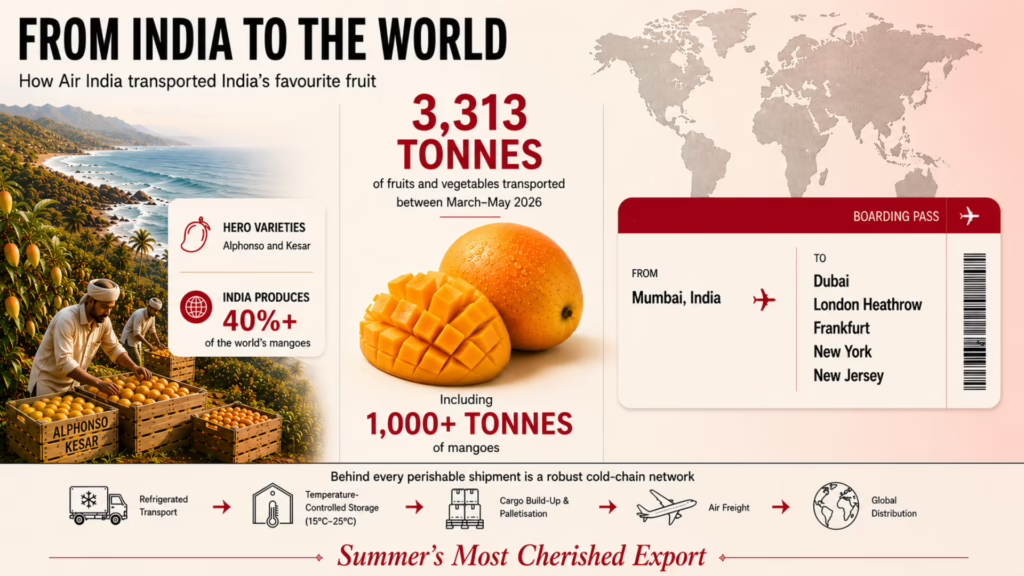
Between March and May 2026, Air India transported more than 3,300 tonnes of fresh produce across its network. Over 1,000 tonnes of that cargo consisted of mangoes, the fruit that occupies a near-mythic place in India’s culinary and cultural imagination, and an equally cherished one among diaspora communities abroad.

For those waiting in distant cities, the mango’s arrival is less a delivery than an event.

A season measured in tonnes
The surge unfolded steadily. In March, as the first consignments began to move, Air India carried 805 tonnes of fruits and vegetables. By April, at the peak of the harvest, that number had risen to 1,275 tonnes, before remaining strong in May at 1,233 tonnes.

Much of this volume traces back to India’s western belt, particularly the mango farms of Maharashtra and Gujarat, where the Alphonso and Kesar varieties are grown. Revered for their sweetness, texture and aroma, these mangoes command loyal followings from Dubai to New Jersey.

And it is Mumbai, with its proximity to this agricultural heartland, that becomes the season’s logistical nerve centre.

From the city’s cargo terminals, shipments fan outward across continents. During this three-month period, London Heathrow saw as much as 180 tonnes of weekly uplift from Mumbai during peak weeks. Frankfurt received around 40 tonnes, while Dubai, Newark and New York JFK each absorbed roughly 30 tonnes weekly.
Courtesy of Air India

Following the fruit
The routes themselves tell a story of migration, taste and memory.

In West Asian cities such as Dubai, Indian mangoes arrive at markets where familiarity runs deep. In London and New York, their appearance signals the start of a brief but intense retail window, where specialty grocers stack crates high and customers buy in bulk, often sending them onward again to friends and family.

From Delhi, Air India’s aircraft continue to carry perishables to cities as far-flung as San Francisco, Toronto, Paris, Hong Kong and Sydney, embedding Indian produce into global supply chains that are commercial in function, yet emotional in significance.

The airline today handles over 400,000 tonnes of cargo annually, making it India’s largest international cargo operator.

The infrastructure of freshness
Yet the journey of a mango from farm to overseas shelf is not merely about distance. It is about time and temperature.

Long before the aircraft doors close, the cold chain is already in motion. Produce arrives at airport terminals in refrigerated trucks, coordinated by IATA-approved agents. At origin, it is stored in temperature-controlled environments, typically maintained between 15°C and 25°C, before being loaded into specialised pallets and containers.

The process repeats itself after landing, where temperature-regulated handling continues until final delivery.

Over the past few years, Air India has invested in strengthening this infrastructure. Today, the airline operates cold-storage and active-container capabilities across 14 airports, including major hubs such as Delhi, Mumbai, Bengaluru, London Heathrow, Frankfurt, and New York’s JFK and Newark airports.

Supporting equipment, from cool dollies to thermal blankets, helps ensure temperature stability is maintained even during brief but critical moments on the tarmac.

These facilities are GDP-certified, aligning them with global standards for handling temperature-sensitive cargo.

“Transporting over 1,000 tonnes of mangoes in just three months reflects both the scale of demand and the robustness of our cold-chain processes,” said Ramesh Mamidala, Head of Cargo, Air India. “Perishables require meticulous handling, and our teams work closely with partners to maintain consistency and quality at every step.”

More than logistics
But to view this movement solely as an operational feat would be to miss its deeper resonance.

Each shipment carries more than produce alone. It carries seasonality, something increasingly rare in a globalised food economy, and a shared anticipation that bridges continents.

For members of the Indian diaspora, the first mango of the season often marks a return, however fleeting, to familiar rhythms. For others, it is an introduction to a fruit that has travelled thousands of miles but arrives with its character intact.

In cities such as London and New York, the mango season is fleeting, its peak lasting only a few weeks. Yet during that time, demand surges, shelves empty quickly, and conversations in homes, markets and online frequently return to one question: Have the mangoes arrived?

Shrinking distances
What Air India’s cargo numbers ultimately reveal is something larger than scale. They trace a seasonal artery between Indian farms and global tables, one that is as much about identity and memory as it is about commerce.

In the span of a single night’s flight, fruits harvested in western India reach kitchens half a world away, still fragrant and still evocative of summer.

It is a reminder that aviation does more than move people. It moves tastes, traditions and expectations, compressing distances not just geographically, but culturally.

And in the quiet belly of a long-haul aircraft, somewhere between Mumbai and London, summer travels, one box of mangoes at a time.

Other Topics: air cargo network, air express, air freight services, Air India, air logistics, Asia Pacific air cargo, Asia Pacific air freight, Asia Pacific air logistics, Asia Pacific shipments, cargo flights, e-commerce logistics, express delivery, express logistics, international air shipments, international express delivery, transpacific air cargo, transpacific air freight

Related Articles

  • AAHK signs Memoranda of Understanding with aviation partners in Central Asia
  • Kuehne+Nagel strengthens own-controlled air freight network with greater global connectivity
  • Xeneta: Global air cargo spot rates jump +41% in May, but some relief may be on the way for shippers
  • From handling to intelligence: Why cargo terminals now shape airline network performance
  • Brussels Airport expands cargo zone with new logistics facility
  • OneReg appoints aviation leader Billie Moore to lead global government affairs and regulatory strategy

Ad – After Content

Primary Sidebar

Trending News

  • CAICargoAi Unveils CargoMART Interline, revolutionising… CargoAi is proud to announce the launch of CargoMART Interline,…
  • lufthansa cargoLufthansa Cargo launches development of innovative… Lufthansa Cargo is developing a new type of virtual reality…
  • cce groupCCE Group and Emirates sign MoU to expand long-term… CCE Group and Emirates have signed a Memorandum of Understanding to explore expanded…
  • ceva logisticsCEVA Logistics reinvents healthcare cold chain in Asia From life-saving vaccines to sensitive biologics, healthcare logistics demands precision,…
  • From L to R - Christopher Lim, Praveen Gregory, Bjoern SchoonDHL Global Forwarding announces strategic leadership… DHL Global Forwarding, the freight specialist arm of DHL Group,…
  • Hactl Executive Director–Information Services John Lee (left) received the ISO IEC 27001 2022 certification from SGS Hong Kong Limited Deputy Director, Products & Services Development Chris Yau (right).Hactl’s COSAC-Plus becomes the first Hong Kong… Hong Kong Air Cargo Terminals Limited (Hactl) – Hong Kong’s largest…
  • Saudia Cargo_Payload Asia 2025Saudia Cargo named ‘Best E-Commerce Carrier –… Saudia Cargo, the leading air cargo carrier in the Middle…

Payload Asia Awards

Subscribe To
Our Newsletter


Payload Asia continues to be the authoritative source for informative, accurate and up-to-date news and information on the air cargo industry and related sectors.

With its updated and refreshed look the online edition continues to provide high quality coverage on the Asia-Pacific, India-Middle East, Europe-CIS, North & South America and Africa air cargo markets.

© 2025 Harvest Information. All rights reserved. Privacy Policy

Partner Sites : Asia Food Journal and Television Asia Plus .

We use cookies and similar technologies to improve your browsing experience.
Continuing to use this site means you agree to our use of cookies. I agreeRead More
Privacy & Cookies Policy

Privacy Overview

This website uses cookies to improve your experience while you navigate through the website. Out of these cookies, the cookies that are categorized as necessary are stored on your browser as they are essential for the working of basic functionalities of the website. We also use third-party cookies that help us analyze and understand how you use this website. These cookies will be stored in your browser only with your consent. You also have the option to opt-out of these cookies. But opting out of some of these cookies may have an effect on your browsing experience.
Necessary
Always Enabled

Necessary cookies are absolutely essential for the website to function properly. This category only includes cookies that ensures basic functionalities and security features of the website. These cookies do not store any personal information.

Non Necessary

Any cookies that may not be particularly necessary for the website to function and is used specifically to collect user personal data via analytics, ads, other embedded contents are termed as non-necessary cookies. It is mandatory to procure user consent prior to running these cookies on your website.

Analytics

Analytical cookies are used to understand how visitors interact with the website. These cookies help provide information on metrics the number of visitors, bounce rate, traffic source, etc.

Performance

Performance cookies are used to understand and analyze the key performance indexes of the website which helps in delivering a better user experience for the visitors.

Advertisement

Advertisement cookies are used to provide visitors with relevant ads and marketing campaigns. These cookies track visitors across websites and collect information to provide customized ads.

Save & Accept

Stay Updated!

Subscribe now to receive the latest news, updates, and exclusive insights. Don’t miss out!


By submitting this form, you consent to receive marketing emails from Payload Asia. You can revoke your consent to receive emails at any time by using the SafeUnsubscribe® link, found at the bottom of every email.

Disclaimer: Translations on this website are automated using Google Translate. While we strive for accuracy, please be cautious, as machine translations may contain errors. For critical or sensitive content, consider seeking professional human translation. We are not liable for any reliance on the translated content.

1