

• Skip to main content
  • Skip to primary sidebar

Ad – Bottom Content

Payload Asia

Cross-border e-commerce: the 21st century spice trade

Payload Asia

  • Home
  • Latest News
  • Channels 
    • Carriers
    • Aircraft Manufacturers
    • Airports
    • Courier & Mail
    • Freight Forwarders
    • Express
    • Ground Handling & Cargo Terminals
    • Logistics
  • 13th Payload Asia Awards
    • About
    • Categories
    • 12th Payload Asia Awards
    • 11th Payload Asia Awards
    • 10th Payload Asia Awards
    • 9th Payload Asia Awards
    • Awards Gallery
  • Subscribe
  • Advertise
  • More 
    • Event Calendar
    • Directory
    • Contact Us
Share

Leaderboard

Payload Asia Awards 2026 - Nominate Now

Cross-border e-commerce: the 21st century spice trade

July 17, 2017 by PLA Editor

Frank-Uwe Ungerer

Amidst recent uncertainties around the themes of globalization and international trade, one thing remains absolutely certain: cross-border trade is here to stay. People have been engaged in international trade for more than five millenniums. According to some of the earliest records of civilization, the exchange of goods was already supported by trading posts established in South Asia and Middle East.


 

Frank-Uwe Ungerer


One of the main commodities was spices, which were highly prized. Traders in the Middle East offered cinnamon and cassia, embellishing their sales pitches with tales about their mysterious origins and properties. And customers loved it: The spice trade flourished and continued through to modern times, on the back of demand for these high value commodities, and the ingenuity of those who worked to source and sell them around the world. It built bridges between different cultures and gave rise to major shipping routes between continents, many of which endure till this day.


Fundamentally, consumers have not changed over the last 5,000 years. As consumers, they still crave exclusive, high quality and exotic goods. They are willing to invest a certain amount of time and effort to seek out what they want at the best price. Merchants are constantly looking for enterprising, creative ways of taking their goods across borders to new markets.  All these have set the stage for cross-border e-commerce – the new ‘spice trade’ phenomenon that will help to shape international trade, transform the world’s supply chains and build new shipping routes in the future



E-commerce is not a particularly new phenomenon. And neither is cross-border e-commerce. People have been able to order – particularly from major online retailers – around the world for years now, and this has helped the cross-border market grow to USD 300 billion up till 2015.


Research insights published recently by DHL Express – in partnership with a leading global management consultancy, has indicated that this business will continue to flourish for years to come. According to the report, this market offers superior growth rates to those available in just about any other retail segment today. Cross-border e-commerce is expected to grow, on average, at nearly twice the rate of domestic online retail by 2020. The market will be three times bigger than what it was in 2015 by then.
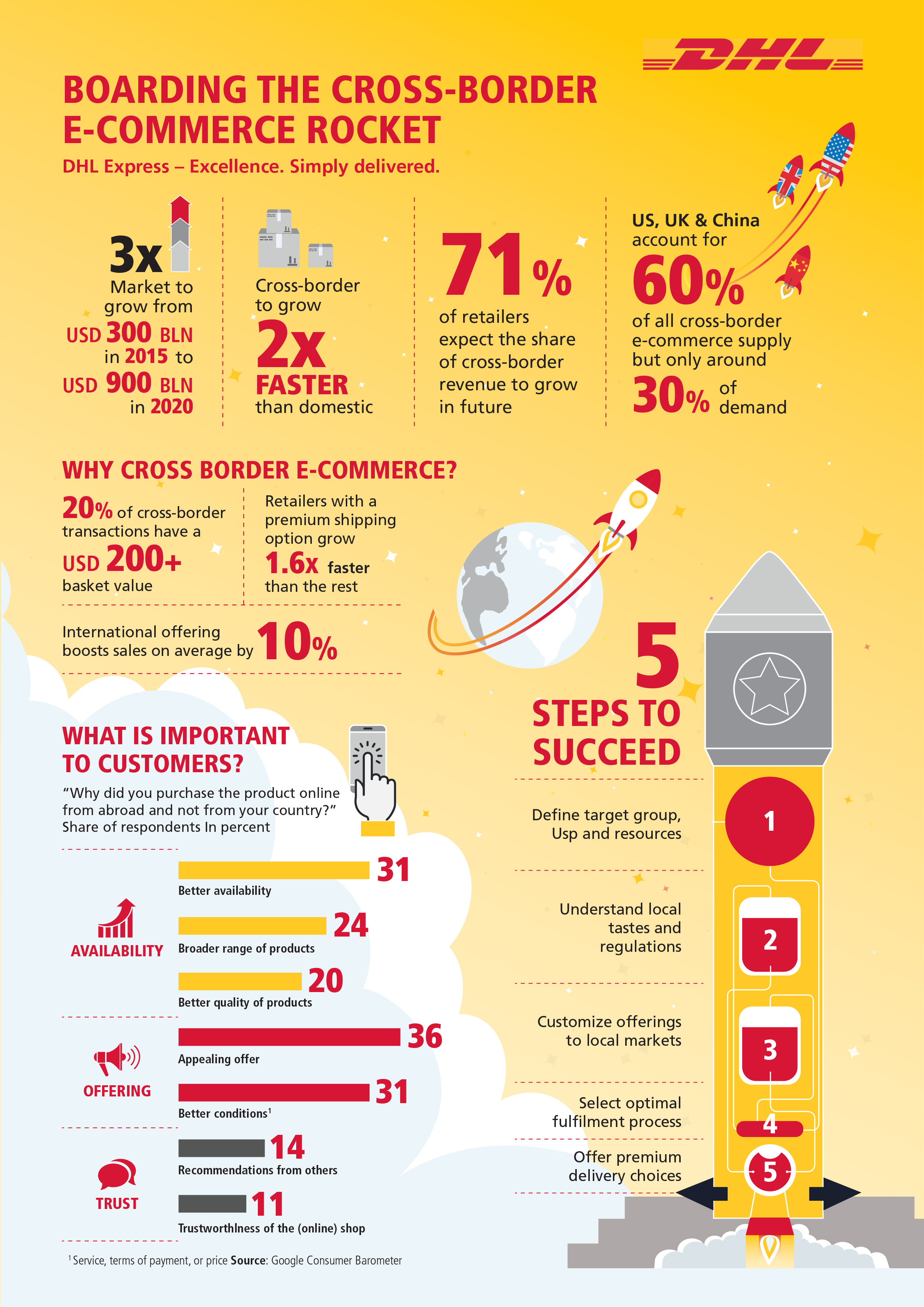


Outside of today’s biggest spice route supply markets—US, UK and China—new spice trade routes have emerged in Singapore, Hong Kong and India, spurred by rising consumer education and e-tailer awareness of opportunity. According to Google’s Consumer Barometer, consumers are motivated to purchase from abroad because of better product availability, more attractive offerings and trust in the brands. And consumers in Singapore (being ranked top alongside Japan, Germany and the UK) also cited better availability as a principal reason for cross-border online purchases.


Cross-border e-commerce also attracts more spend from customers, with 20 per cent of cross-border purchases having a basket value of more than USD200. The global map for high-basket value route transaction is diverse, with the USD30 billion market of high-basket value transactions being evenly divided between Asia, Europe and North America. Singapore, Hong Kong and India have been earmarked as key Asian markets from which spice routes for high-value purchases are being expanded and with growth rates up to two or three times higher than the global average.


The premium aspect of cross-border commerce is worth noting. According to our research, retailers who offer a premium service offering (including faster delivery) are growing 60 per cent faster than the average. This is driven in part by the fact that fashion and technology still account for a substantial proportion of cross-border sales. However, the premium opportunity is there for every product, both in terms of what the retailer offers and what the customer demands.


This all makes for a compelling case for building an online offering (with a premium option) that is also open for business to overseas customers, whatever your product. Importantly, as we see within our own customer base at DHL Express, this is much, much easier than many people think. The main barriers cited by customers to buying something from overseas are logistics, trust, price and customer experience. Today, with reliable global door-to-door logistics networks connecting businesses with customers and enabling easy returns anywhere in the world within days, and off-the-shelf solutions making website visits, price calculations and transactions possible in just about any language or currency, you can address the vast majority of these concerns.


There is a modern-day spice trade emerging, which I strongly encourage every retailer to take a serious look at. It requires a new skill-set, a new mind-set and new approaches to managing inventories, supply chains and even customer interactions. But it offers a definite growth opportunity for all retailers and manufacturers – customers surveyed for our research reported an average sales boost of 10 per cent through simply having a cross-border option. For those entrepreneurs and markets that can connect most effectively with the global market, it will deliver handsome rewards. Most importantly, it will highlight the most positive aspects of global trade, allowing everyone – wherever they are in the world – to exploit the very best of their unique culture, skills and creativity to trade with the world, grow and build prosperity.


Other Topics: Air & Cargo Services, air cargo, Air Cargo Asia, air cargo freight, Air Forwarding, air freight, Air Freight Asia, Air Freight Logistics, air freighter, air freighting, Air Logistics Asia, Air Shipping Asia, airlines cargo, airways cargo, asia cargo news, cargo aviation, cross-border e-commerce, DHL, Frank-Uwe Ungerer

Related Articles

  • DHL expands dedicated Transpacific air network with new three-times weekly flights from Bangkok to Cincinnati
  • Locatory.com integrates aircraft parts marketplace with shipping services
  • Cathay Cargo adds an Airbus A330 freighter from Air Hong Kong to support further growth
  • DHL Global Forwarding Japan launches Explosives Detection Dog screening with Sanko Total Service to enhance air cargo security and screening efficiency
  • DHL expands Asia Pacific data centre logistics capabilities to support growing regional demand
  • ECS Group invests in scalability to meet Asia’s air cargo demand

Ad – After Content

Primary Sidebar

Trending News

  • CAICargoAi Unveils CargoMART Interline, revolutionising… CargoAi is proud to announce the launch of CargoMART Interline,…
  • lufthansa cargoLufthansa Cargo launches development of innovative… Lufthansa Cargo is developing a new type of virtual reality…
  • cce groupCCE Group and Emirates sign MoU to expand long-term… CCE Group and Emirates have signed a Memorandum of Understanding to explore expanded…
  • ceva logisticsCEVA Logistics reinvents healthcare cold chain in Asia From life-saving vaccines to sensitive biologics, healthcare logistics demands precision,…
  • From L to R - Christopher Lim, Praveen Gregory, Bjoern SchoonDHL Global Forwarding announces strategic leadership… DHL Global Forwarding, the freight specialist arm of DHL Group,…
  • Hactl Executive Director–Information Services John Lee (left) received the ISO IEC 27001 2022 certification from SGS Hong Kong Limited Deputy Director, Products & Services Development Chris Yau (right).Hactl’s COSAC-Plus becomes the first Hong Kong… Hong Kong Air Cargo Terminals Limited (Hactl) – Hong Kong’s largest…
  • Saudia Cargo_Payload Asia 2025Saudia Cargo named ‘Best E-Commerce Carrier –… Saudia Cargo, the leading air cargo carrier in the Middle…

Payload Asia Awards

Subscribe To
Our Newsletter


Payload Asia continues to be the authoritative source for informative, accurate and up-to-date news and information on the air cargo industry and related sectors.

With its updated and refreshed look the online edition continues to provide high quality coverage on the Asia-Pacific, India-Middle East, Europe-CIS, North & South America and Africa air cargo markets.

© 2025 Harvest Information. All rights reserved. Privacy Policy

Partner Sites : Asia Food Journal and Television Asia Plus .

We use cookies and similar technologies to improve your browsing experience.
Continuing to use this site means you agree to our use of cookies. I agreeRead More
Privacy & Cookies Policy

Privacy Overview

This website uses cookies to improve your experience while you navigate through the website. Out of these cookies, the cookies that are categorized as necessary are stored on your browser as they are essential for the working of basic functionalities of the website. We also use third-party cookies that help us analyze and understand how you use this website. These cookies will be stored in your browser only with your consent. You also have the option to opt-out of these cookies. But opting out of some of these cookies may have an effect on your browsing experience.
Necessary
Always Enabled

Necessary cookies are absolutely essential for the website to function properly. This category only includes cookies that ensures basic functionalities and security features of the website. These cookies do not store any personal information.

Non Necessary

Any cookies that may not be particularly necessary for the website to function and is used specifically to collect user personal data via analytics, ads, other embedded contents are termed as non-necessary cookies. It is mandatory to procure user consent prior to running these cookies on your website.

Analytics

Analytical cookies are used to understand how visitors interact with the website. These cookies help provide information on metrics the number of visitors, bounce rate, traffic source, etc.

Performance

Performance cookies are used to understand and analyze the key performance indexes of the website which helps in delivering a better user experience for the visitors.

Advertisement

Advertisement cookies are used to provide visitors with relevant ads and marketing campaigns. These cookies track visitors across websites and collect information to provide customized ads.

Save & Accept

Stay Updated!

Subscribe now to receive the latest news, updates, and exclusive insights. Don’t miss out!


By submitting this form, you consent to receive marketing emails from Payload Asia. You can revoke your consent to receive emails at any time by using the SafeUnsubscribe® link, found at the bottom of every email.

Disclaimer: Translations on this website are automated using Google Translate. While we strive for accuracy, please be cautious, as machine translations may contain errors. For critical or sensitive content, consider seeking professional human translation. We are not liable for any reliance on the translated content.

1