
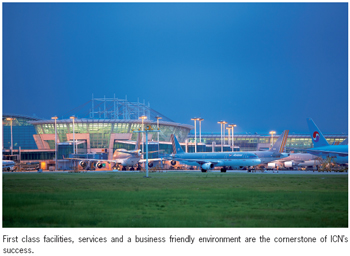
Despite its first class facilities, services and business friendly policies, Incheon Int’l Airport (ICN) has often found itself in the shadow of more traditional hubs in the region, but this is changing as companies look to extract the ultimate value out of their supply chains.
“Even though we have gotten rid of many regulations and significantly improved the business environment, it seems like people tend to bring traditional hubs such as Hong Kong and Singapore into their mind when they were asked to name cargo hubs in Asia,” an Incheon spokesperson told Payload Asia.

There is of course a certain irony in this, considering that Incheon is ranked as the fourth largest cargo airport in the world behind number one Memphis (thanks to FedEx), Hong Kong and Shanghai and ahead of Charles de Gaulle, Tokyo Narita, Frankfurt, Louisville (UPS), Miami and Singapore which comes in at number 10.
Last year Incheon’s five cargo terminals with 36 cargo stands covering over 1.1 million square metres handled 2.56 million tonnes of cargo, a 9.4 per cent gain over the previous year and effectively would have maxed out the capacity of the airport had Incheon not expanded its capacity last year to 4.1 million tonnes.
Based on the total cargo throughput of each carrier in 2007, the top ten cargo carriers are Korean Air, Asiana Airlines, Southern Air, Cathay Pacific Airways, Polar Air, FedEx, Northwest Airlines, UPS, Lufthansa and Thai Airways at number 10.
“We’re planning ahead for the third expansion, which would raise our capacity again to 4.7 million tonnes. This, we assume will start around 2011-2012, completing in 2015. Following expansion schedules would be adjusted based on the need of our customers, but our cargo terminal expansion plan continues until 2035, with cargo handling capacityreaching 9.1 million tonnes in the final phase,” the spokesperson said.
The five terminals are operated by Korean Air, Asiana Airlines, Atlas Air (Polar), DHL and a common user terminal – Foreign Carrier Cargo Terminal – which is used by carriers including: FedEx, UPS, TNT, Lufthansa Cargo, Cargolux, ANA Cargo, China Cargo Airlines.
operated in BTO (Build-Transfer-Operate) method, and the last two are operated in BOT.
Incheon also has an Airport LogisPark located within the Free Trade Zone and right next to the cargo terminal for logistics and manufacturing companies. The LogisPark covers a land area of 1 million square meters and another 1.4 million square meters will be developed by 2011. Global companies such as Schenker, KWE and AMB are currently operating at the Airport LogisPark.

Incheon’s value proposition
But the airport’s value proposition is clearly a unique combination of geographic location and businessminded development strategy.
“We are strategically located between Japan and China, having 61 cities with the population over 1 million within 3.5 hrs of flying time. As this favourable location suggests, we have massive air network throughout the world, connecting 162 cities with 70 airlines worldwide as of May 2008,” according to the spokesperson.
The connectivity is clearly impressive when considering that according to OAG data, Hong Kong, Singapore, and Shanghai only connected 124 cities, 121 cities and 106 cities respectively in 2007.
“Moreover, we have the best connectivity to China and Japan as we connect 36 cities in China and 25 cities in Japan, as of May 2008. Tokyo (Narita) only served 10 cities in China and Shanghai (Pudong) only served 14 cities in Japan last year. We could also connect cities in North America nonstop, of which weserved 25 cities as of May 2008.”
But aside from this the airport has also focused on pragmatic business policies to woo more business. “We have very competitive turn-around charges. We reduced landing fees by 10 per cent last year and this had a dramatic eff ect as landing fees take up about 74.4 per cent of turn-around charges,” the spokesperson said.
By cutting down the price, Incheon’s turn-around charges are now 47-89 per cent lower than that of neighboring countries, according to the airport.
Add to this an advanced customs system in which the entire system is 100 per cent paperless with all documents submitted through an EDI (Electronic Data Exchange) system or internet, making the process quick and streamlined. The eclearance is a one-stop service at a single window, linking 22 related services of 12 government agencies all on one site.
“We also provide 24/7 clearance with real-time cargo processing information from arrival to out-bound and offer onsite clearance at warehouses without visiting customs office. Naturally, we have the fastest customs clearance system among 169 World Customs Organisation member countries (export and import clearance only takes 2 minutes and 2.5 hours respectively),” the spokesperson said.
In order to ensure that top-notch service standards are maintained, Incheon maintains a cargo service performance index, which includes landside services and cargo breakdown, with quarterly reporting.
“We make continual adjustments to raise our service level even higher. This proves that we are steps ahead of China or other countries in software and service,”the spokesperson added.

Mild impact from downturn
Looking to build on last year’s 2.6 million tonnes of cargo Incheon had, at the start of this year, set a target of 2.8 million tonnes for the year, but surging oil prices and the global economic slowdown put a damper on those ambitions.
Th is figure has, like most airports around the world, been downgraded slightly with with a total cargo throughput for 2008 being forecast to come in slightly above last year’s 2.6 million.
But things are looking up as cargo volumes at the end of the third quarter, amounted to 1.9 million tonnes of cargo – a 0.2 per cent increase from the same period last year.
While total cargo throughput up to the end of the third quarter this year showed a marginal 0.2 per cent growth from last year, volumes during July and August declined three per cent largely due to a scaling back of frequencies by carriers due to high oil prices and a weak Korean won against US Dollar.
Also, a number of major IT export/ import items decreased as the global economy slowed.
But putting Incheon’s three per cent decline in perspective, IATA data shows that over all, Asia-pacific experienced a larger decline in total cargo throughput during that same period with an average 6.7 per cent contraction in total throughput.
Most notably, cargo volume to and from North America decreased, leading total cargo volumes to drop in the third quarter. However, cargo volume to and from China and South East Asia is still maintaining firm growth at 7.2 per cent and 2.2 per cent respectively, which helped off set the impact of the US-led global economic slowdown, the spokesperson said.
Indeed, Incheon’s partial insulation from the worst of the downturn can be attributed to its wide distribution of cargo sources. Of its total throughput, Japan accounted for 12 per cent, China 26 per cent and Southeast Asia 17 per cent. Outside of Asia, North America accounted for 24 per cent and Europe 18 per cent.
Until the end of 3rd quarter, transshipment cargo took up about 49 per cent of total cargo throughput which gives Incheon the highest transshipment rate in the region, which reached more than 50 per cent last year, setting a record for the airport since its opening in 2001. Last year maindeck cargo comprised 60 per cent of the total throughput while the remainder was belly-hold cargo.
The top three export commodities, year-to-date, are telephones for wireless networks, memory boards, processors and controllers. The top three import commodities year-to-date are processor and controllers, memories, and machines and apparatus for the manufacturing of semiconductor devices or electronicintegrated circuits.
Looking ahead
On an optimistic note, Incheon feels the downturn is only a short term trend with the market returning to growth in due course.
The airport will also get a boost from its key customer, Korean Air, which made the decision in October to convert eight B747-400 passenger aircraft into freighters by 2010 and buy two freighters each year over the period 2010-2015.
This would more than double Korean Air’s capacity from today’s 18 B747s to 38-40 B747s by 2015. Korean Air also recently launched new freighter services to Chennai (India) and Seattle (US). Th ey also plan to launch a freighter to Miami (US), Xiamen (China) and Stockholm (Sweden).
To accommodate the increased number of freighters, Korean Air will double the current MRO facilities it has at the airport by 2012. Asiana Airlines is also planning an expansion of their MRO facilities by nearly four times its current size by 2011.
And with an eye on increasing the total cargo throughput and invigorating business at its Free Trade Zone, Incheon is actively wooing global manufacturing companies to build international distribution centres.
“In order to accomplish this, we simplified re-export procedures and made improvements in the export of strategic goods procedures and corporate income tax regulations recently.
“As a result, ASML, the world’s third largest manufacturer of advanced technology systems for the semiconductor industry and the leader in sales of lithography systems headquartered in the Netherlands, and SONY both chose Incheon as their global and Northeast Asia distribution centre in July and August, respectively,” the spokesperson highlighted.
The success in attracting both these companies is a bit of coup for Incheon, not to mention a concrete indication of its success in getting out of the shadow of its older rivals, as ASML originally had a hub in Singapore and Taiwan and SONY also moved its Northeast Asia hub from Hong Kong.
“These show Incheon is not by any means behind the traditional hubs. Our challenge is to change the notion of cargo airlines, logistics and manufacturing companies through extensive marketing, that we can provide so much more than they have thought of,” the spokesperson said.
The hard-sell
And in that never-ending quest for more business, Incheon participates in major cargo forums and exhibitions and more importantly, offers a wide-ranging array of financial incentives.
“To bring new carriers in we examine the market where the carrier is operating and suggests how they would benefit from connecting Incheon through various means.” The airport also has a raft of incentives up its sleeve which it extends to airlines, logistics and manufacturing companies starting a new business at Incheon.
For new carriers, a reduction of 100 per cent of landing charges and 50 per cent of office rental are given for a year. For carriers adding new destinations, expanding frequency and operating in off -peak and high night periods also get favourable incentives.
For logistics and manufacturing companies, tax incentives are given, if they meet the minimum FDI condition of US$5 million for logistics and US$10 million for manufacturing companies. Corporate and income taxes are exempted for the first three years and a 50 per cent discount is given for the following two years.
Acquisition, Registration and Property taxes are exempted for 10 to 15 years. Land rental fees are also exempted or discounted for 5 to 15 years according on the FDI amount invested. In addition, according to the proportion of transshipment cargo from total cargo throughput, a discount on land rental fee of 50 per cent will beapplied for that proportion.

Emerging trends
The other unique strategy the airport is working to develop, is a new business model based around a multimodal supply chain. With Incheon Port only 30 minutes away from the airport, Incheon is tapping the direct sea links to northern China like Qingdao, Dalian, Weihan and Yantai with a sea/air service.
Up to the third quarter this year, Incheon processed 43,000 tonnes of sea/air cargo which is 30.8 per cent up from the last year and the volumes are showing a continual double digit growth, despite the slowdown in the global economy.
To boost the multimodal transportation up another notch, Incheon launched the Road Feeder Service to and from China last year.
Another related trend that Incheon is seeing is movement by carriers into non-traditional multimodal transportation. Asiana Airlines, for instance, in February purchased the biggest logistics company in Korea, Korea Express. Now with Korea Express, Asiana has a multimodal network covering land, sea and air.
Similarly, for Korean Air, where its parent company Hanjin, also operates Hanjin Express.
“The trend,” said the spokesperson, “is for major airlines is to provide better and unique services to their customers with multimodal transportation.”
The express business
Express, while a relatively small proportion of Incheon’s overall cargo volumes at around 5 per cent of total cargo, or 130,000 tonnes annually, it is none-the-less a key part of its cargo business.
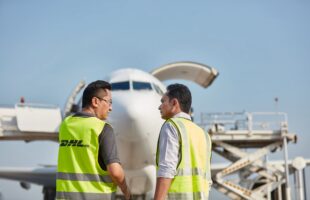
DHL began building its Intercontinental Hub last year with operations beginning this coming January. Korea Post opened its International Express Mail Centre last December as their EMS (Express Mail Service) is showing a continual growth in the market.
Hyundai Express also opened Air Cargo Centre last August to further penetrate the express market.
“We believe competition among global and local companies will intensify as the express market in Korea is expected to grow at a signifi cant rate in the coming years.” According to Incheon’s own research, it estimates that the express volumes will grow up to 10 times until 2035, or around 1 million tonnes comprising 15 per cent of the total cargo throughput at that point.
This has led the airport to plan for a designated area for express carriers, including an expansion of the ramp area to 117 cargo stands by 2035. Parking will also be created immediately in front of the terminal to ensure smooth operational flows during peak periods.
Aside from DHL, Korea Post and Hyundai Express, the other key express operators utilising Incheon are FedEx, UPS, TNT, Korea Express and HanjinExpress.